
When a spreadsheet becomes the operating system, build the system it was standing in for
A focused internal tool moved a fragile spreadsheet workflow into production in roughly 2–3 weeks and returned about 295 hours to Operations every month.
295 hours/month
Manual entry removed
Operations reported approximately 295 hours of manual entry saved in the first month, with the savings continuing afterward.
2–3 weeks
Conversation to operational use
The focused application moved from initial workflow discussions to a usable internal product in roughly two to three weeks.
Existing data
Active work preserved
Spreadsheet ingestion let the team transition without discarding or manually rebuilding current records.
The real situation
The spreadsheet was useful because it bridged a real gap: several clients still relied on legacy systems that were not connected to the company’s newer platform. Operations used the file to find records, review them, make updates, and move work forward.
Over time, the workaround became a business dependency. Repeated entry and maintenance consumed approximately 295 hours every month, and the workflow depended on a flexible file carrying responsibilities it had never been designed to own.
What the business was carrying
The visible problem
- Operations needed the process to keep moving while legacy clients remained outside the newer platform.
- The spreadsheet contained active work that could not simply be abandoned or recreated by hand.
- Important status and update decisions depended on repeated manual handling.
Why the obvious fix was not enough
The harder system underneath
- Replacing the file without understanding the work would have produced a cleaner-looking version of the same burden.
- The new tool had to preserve existing records, familiar steps, and the transitions Operations actually used.
- The solution needed to be small enough to deliver quickly without becoming another disposable workaround.
The operating shift
The file became input instead of the place the business lived
The value did not come from replacing a spreadsheet on principle. It came from preserving the useful workflow while moving status, updates, and transitions into a purpose-built system.
Before
- Emailed or shared spreadsheet
- Repeated manual entry
- Active work trapped in a file
- Knowledge concentrated in a few people
After
- Approximately 295 hours returned monthly
- Searchable structured records
- Clear workflow transitions
- Less spreadsheet and tribal-knowledge risk
- 01
Discover
Map the actual work
Find the decisions and transitions hiding inside the file.
- 02
Structure
Define the smallest useful workflow
Keep the process focused enough to deliver quickly.
- 03
Transfer
Import existing records
Move active work without forcing the team to start over.
- 04
Operate
Search, update, and advance work
Give Operations one controlled place to manage the workflow.
What changed
Decisions that moved the work forward
- 1 Understand
Treat Operations as the product user
I met directly with the people doing the work, sketched the workflow, and separated essential actions from spreadsheet habits that did not need to survive.
- 2 Define
Reduce the process to a focused product
I translated the workflow into implementation-ready stories centered on finding a record, reviewing it, updating structured fields, and moving it through a defined transition.
- 3 Build
Create the internal application
I implemented the purpose-built React and Node.js tool, including search, structured updates, workflow transitions, and spreadsheet ingestion.
- 4 Adopt
Move active work without starting over
Existing spreadsheet data was imported so Operations could adopt the application without losing current records or manually recreating the backlog.
What the business gained
Results beyond the implementation
01
Operations gained a searchable, structured workflow instead of relying on repeated spreadsheet handling.
02
Existing work moved into the application without a disruptive restart.
03
The company measured success in staff time returned, not in how much software was shipped.
What this proves for a client
The scale may change. The systems judgment still transfers.
This is the kind of project MethodMade recommends when a spreadsheet is no longer just a file. When it carries status, ownership, business rules, and daily decisions, the opportunity is to preserve what works while moving the risky parts into a clearer system.
Technical footprint
Evidence and boundaries
- ✓ React and Node.js application built from scratch
- ✓ Existing spreadsheet data ingested
- ✓ Roughly 2–3 week delivery
- ✓ Approximately 295 hours per month saved
Client identities, spreadsheet contents, exact fields, internal services, and proprietary dispute workflows remain generalized.
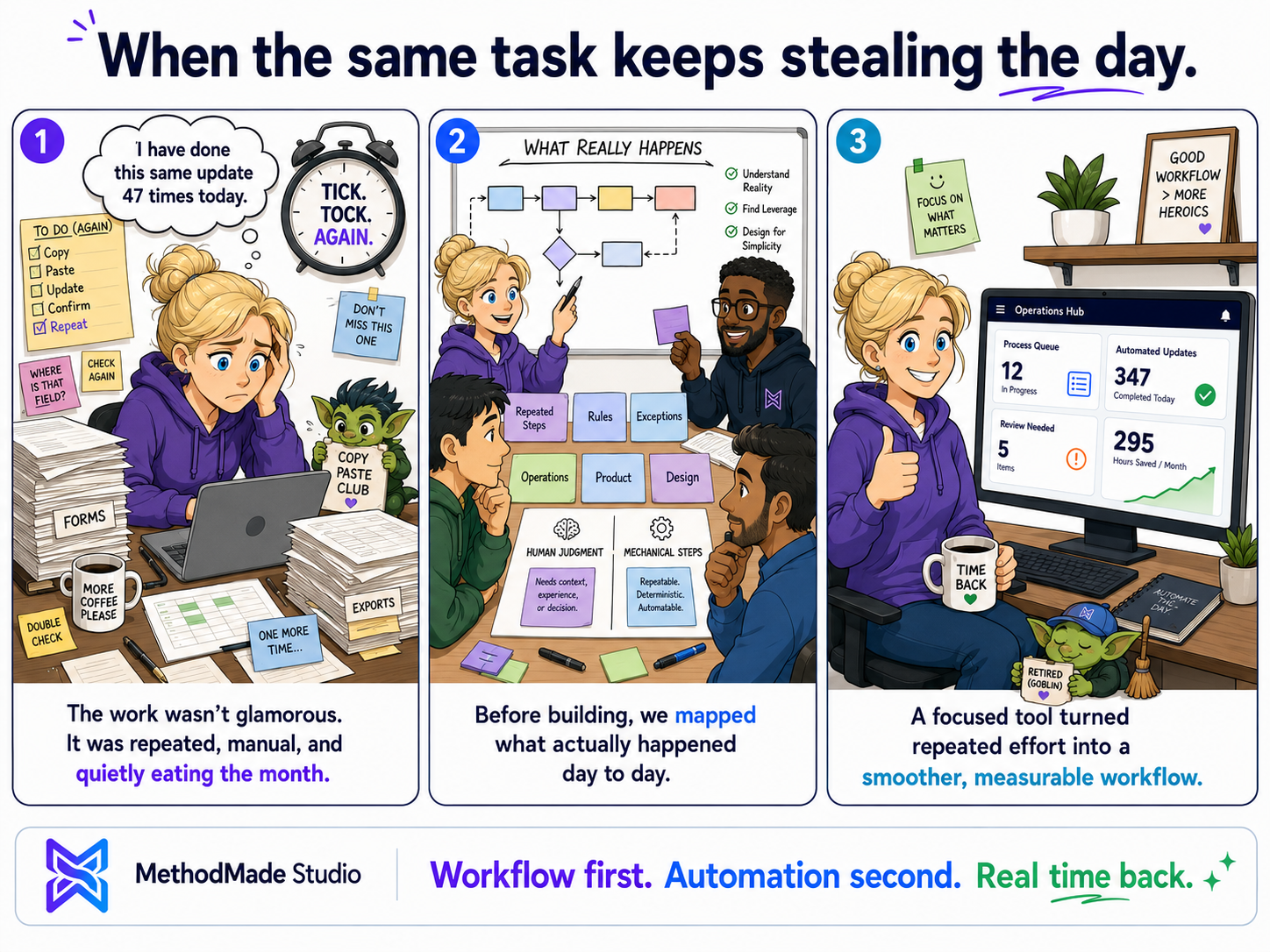
Visual recap
From spreadsheet risk to a workflow the team could trust.
Related practical guide
When a Spreadsheet Becomes a Business System
Read the guide →Related experience
A practical next step
Find out whether the spreadsheet needs cleanup, connection, or replacement
A short workflow review can reveal whether the real need is a better file, a small automation, or a focused internal tool.