
When one exception threatens an important relationship, solve the exception first
A loosely defined client commitment became a stable standalone production tool within one week, giving an at-risk account a workable path into the company’s primary platform.
1 week
Production delivery
The application moved from loose requirements to a working production launch within the existing client commitment.
Retained
At-risk client relationship
The client stayed and gained a usable path for moving the nonstandard data into the platform.
Stable
Post-launch behavior
The focused application worked at launch without significant corrective rework afterward.
The real situation
An important client had a nonstandard data workflow that could not move directly into the company’s merchant-facing platform. The relationship was at risk, and Engineering received a one-week commitment before the technical work had been fully assessed.
This was not the moment for a broad platform redesign. The responsible move was to define the smallest production workflow that could let the client and the internal Support team review incoming records, correct them, understand status and errors, and submit complete data into the primary system.
What the business was carrying
The visible problem
- The client’s data structure did not fit the standard product workflow.
- Support relied on manual workarounds while the client waited for a dependable solution.
- The commercial commitment allowed only one week for production delivery.
Why the obvious fix was not enough
The harder system underneath
- The requirements were loose while the deadline and business outcome were not.
- The application had to connect multiple services, data models, persistence, submission, testing, and deployment concerns.
- Fast delivery would have been worthless if the tool mishandled data or required major corrective rework after launch.
The one-week scope
Solve the business-critical path, not every adjacent possibility
The deadline forced discipline: define one usable path, keep the interface simple, test the consequential parts, and escalate before hidden system knowledge became launch risk.
Before
- Nonstandard client data
- Manual Support workarounds
- Relationship at risk
- Loose requirements and a fixed one-week promise
After
- Stable standalone tool
- Shared client and Support workflow
- At-risk account retained
- No significant corrective rework
- 01
Day 1
Reduce the request
Choose the minimum list, form, status, error, and submission workflow.
- 02
Days 1–3
Build the full-stack path
Implement the interface, persistence, service connections, and tests.
- 03
Day 4
Pair on cross-system integration
Bring in the engineer with the deepest platform context.
- 04
By week end
Validate and launch
Complete production wiring, manual checks, and deployment.
What changed
Decisions that moved the work forward
- 1 Narrow
Define the smallest reliable production path
I reduced the request to one shared list-and-form workflow for reviewing incoming records, correcting fields, seeing status and errors, and submitting finalized data.
- 2 Build
Own the full-stack application
I created the standalone React and Node.js product across its interface, persistence, service integrations, testing, and deployment needs.
- 3 Protect
Keep polish proportional to the deadline
The visual design remained intentionally barebones so the week stayed focused on data integrity, workflow clarity, and a stable production path.
- 4 Escalate
Bring in the right system knowledge
After the initial solo build, I paired with the engineer who had the strongest cross-system context to complete final wiring, validation, and deployment safely.
What the business gained
Results beyond the implementation
01
The client and Support team used the same controlled interface during the transition.
02
The unusual workflow was contained in a focused application rather than forcing a risky change into the core product.
03
The project protected the account while producing a stable, maintainable production path.
What this proves for a client
The scale may change. The systems judgment still transfers.
Not every exception justifies rebuilding the main platform. A focused tool can protect a customer relationship, remove a high-friction workaround, and buy the business time to make a larger product decision deliberately.
Technical footprint
Evidence and boundaries
- ✓ One-week production window
- ✓ Standalone React and Node.js application
- ✓ Automated and manual testing
- ✓ Client retained
- ✓ Stable launch
The client, account value, internal application name, schemas, services, endpoints, and proprietary business rules remain generalized.
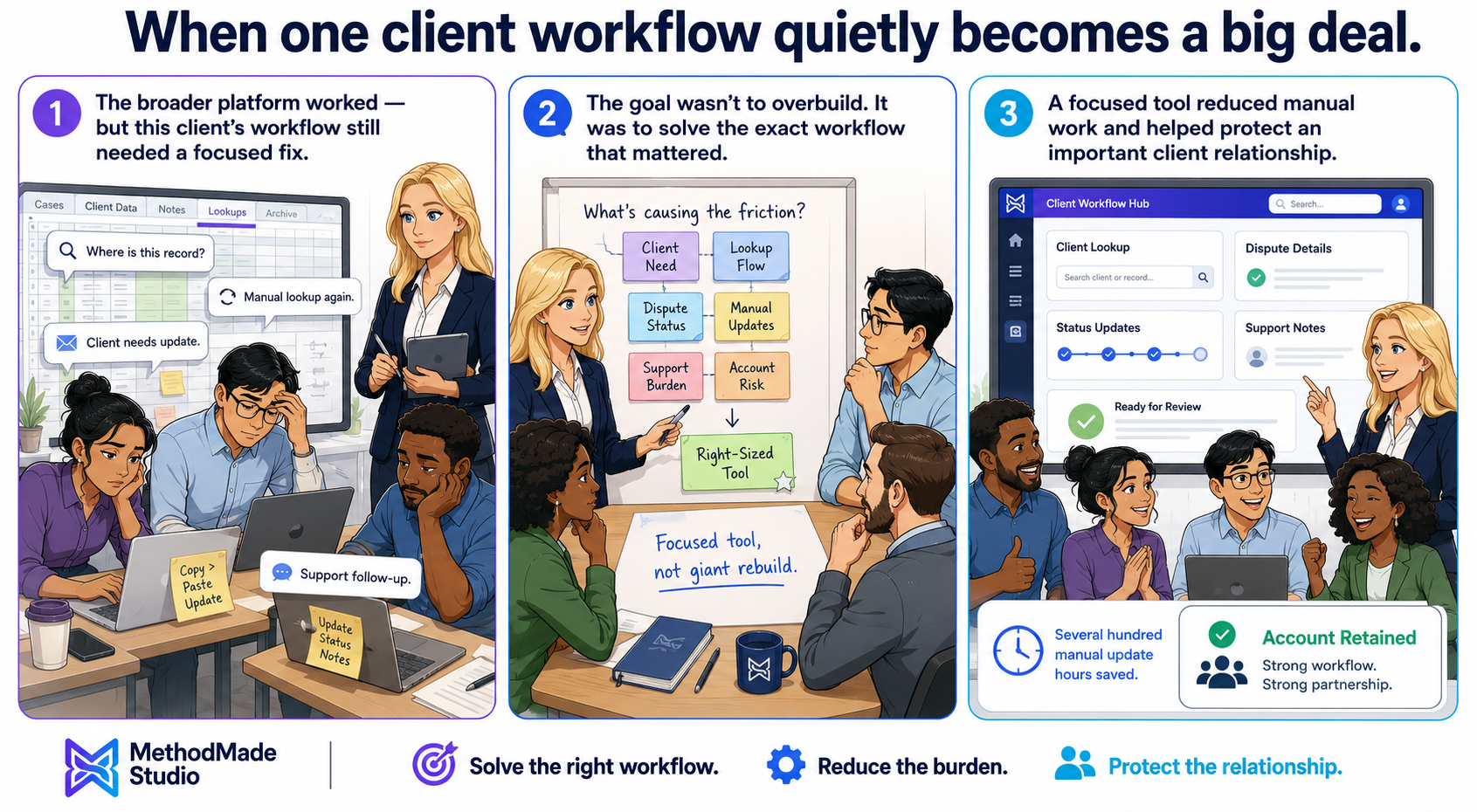
Visual recap
From manual exception handling to a stable client-saving tool.
Related practical guide
Is the Manual Process Ready for a Tool?
Read the guide →A practical next step
Solve the expensive exception before it becomes the whole roadmap
We can separate the urgent workflow from the surrounding wishlist and define the smallest useful build.