
1
Repeat
- Discovery stages
- Required inputs
- Review checkpoints
Repeatable Website Delivery
A consistent website process can make projects easier to plan, review, launch, and maintain without forcing every client into the same design or message. Standardize the steps that prevent confusion while keeping the business story and customer decisions specific.
Repeatable delivery
Website work often falls into two extremes. Every project starts from zero, so timelines and quality depend on memory; or efficiency becomes sameness, so every client receives the same pages and vague language with a different color palette. A repeatable process should create a dependable path through discovery, content, design, development, review, launch, and maintenance while leaving the actual business decisions specific. The process repeats. The business does not.
A dependable process should make good decisions easier to reach. It should not quietly decide the client’s story, customers, proof, tone, or priorities in advance.
Repeat the parts that prevent avoidable confusion: gathering access, learning who the site must help, collecting customer questions, reviewing proof, planning pages, checking forms, testing quality, preparing launch, and documenting maintenance.
Keep positioning, best-fit customers, service explanations, proof, tone, visual direction, calls to action, and customer expectations specific to the business. Those are not interchangeable details; they are the substance of the site.
A small discovery set can repeat because every useful website needs to clarify fit, trust, services, customer questions, next steps, approval, and ownership. The answers should come from real conversations, customer behavior, business boundaries, and the way the work actually happens.
A repeated question is a tool for thinking. A repeated answer is usually a shortcut toward generic work.
Two-track delivery
Repeat the path to good decisions. Do not repeat the decisions themselves.
Reusable page structures and visual rules are helpful when they support the message. They become harmful when the available component decides what the client is allowed to say.
Collect service notes, customer questions, reviews, credentials, photographs, policies, forms, access, and examples of real explanations before producing a full set of polished layouts. The material does not need to be final, but it should be realistic enough to reveal what the page actually needs.
Designing around placeholder copy can hide missing proof, unclear services, unusually long explanations, and customer decisions that do not fit the assumed template.
A reusable service-page pattern can ask about the customer situation, fit, scope, process, proof, and next step. It should not require every client to answer with the same amount of text, the same evidence, or the same visual arrangement.
The pattern keeps the page complete. The content and customer journey determine how that completeness is expressed.
Agree on typography, spacing, buttons, colors, forms, notices, images, headings, and mobile behavior so the website feels coherent and remains easier to maintain.
Those rules are building blocks, not a demand that every service, story, comparison, and contact path use an identical composition. Reuse should support the meaning rather than overpower it.
Projects often stall between people. Clear readiness conditions and well-timed reviews reduce rework without turning delivery into a bureaucratic obstacle course.
Content should not reach design with major facts unresolved. Design should not reach development without mobile behavior, forms, and unusual states understood. A site should not reach review with placeholder material, and it should not reach launch without ownership, redirects, backups, forms, analytics, and monitoring confirmed.
Write only the readiness conditions that prevent real waiting or rework. The goal is a reliable handoff, not documentation for its own sake.
Confirm the site map before drafting every page. Review one representative page before designing the full site. Approve the visual direction before producing many variations. Test a service pattern and the contact path before launch week.
Small reviews expose misunderstandings while they are still inexpensive to fix. They also give clients something concrete to react to instead of asking them to imagine the final result from abstract descriptions.
A shared quality checklist should cover mobile and desktop layouts, links, forms, confirmations, content accuracy, accessibility, performance, privacy, redirects, analytics, backups, and recovery.
The checklist cannot decide whether the page feels honest, whether the proof supports the claim, or whether the right customer understands what to do. People still need to pay attention.
A repeatable project is not complete when the site goes live. Ownership, maintenance, training, and learning belong inside the delivery process from the beginning.
Document where accounts and ownership live, how common content is updated, which patterns should be reused, how forms are tested, how backups and recovery work, and which changes should return to a specialist.
Train people on the work they will actually perform. A useful handoff is not a tour of every feature in the website editor; it is enough confidence and context to manage ordinary responsibilities safely.
After launch, review what arrived too late, caused waiting, confused the client, prevented a defect, had to be recreated, or became less specific through over-reuse. Update the process when a lesson repeats—not every time one unusual project behaves unusually.
The purpose of learning is to remove avoidable confusion while preserving the judgment that makes each website genuinely useful.
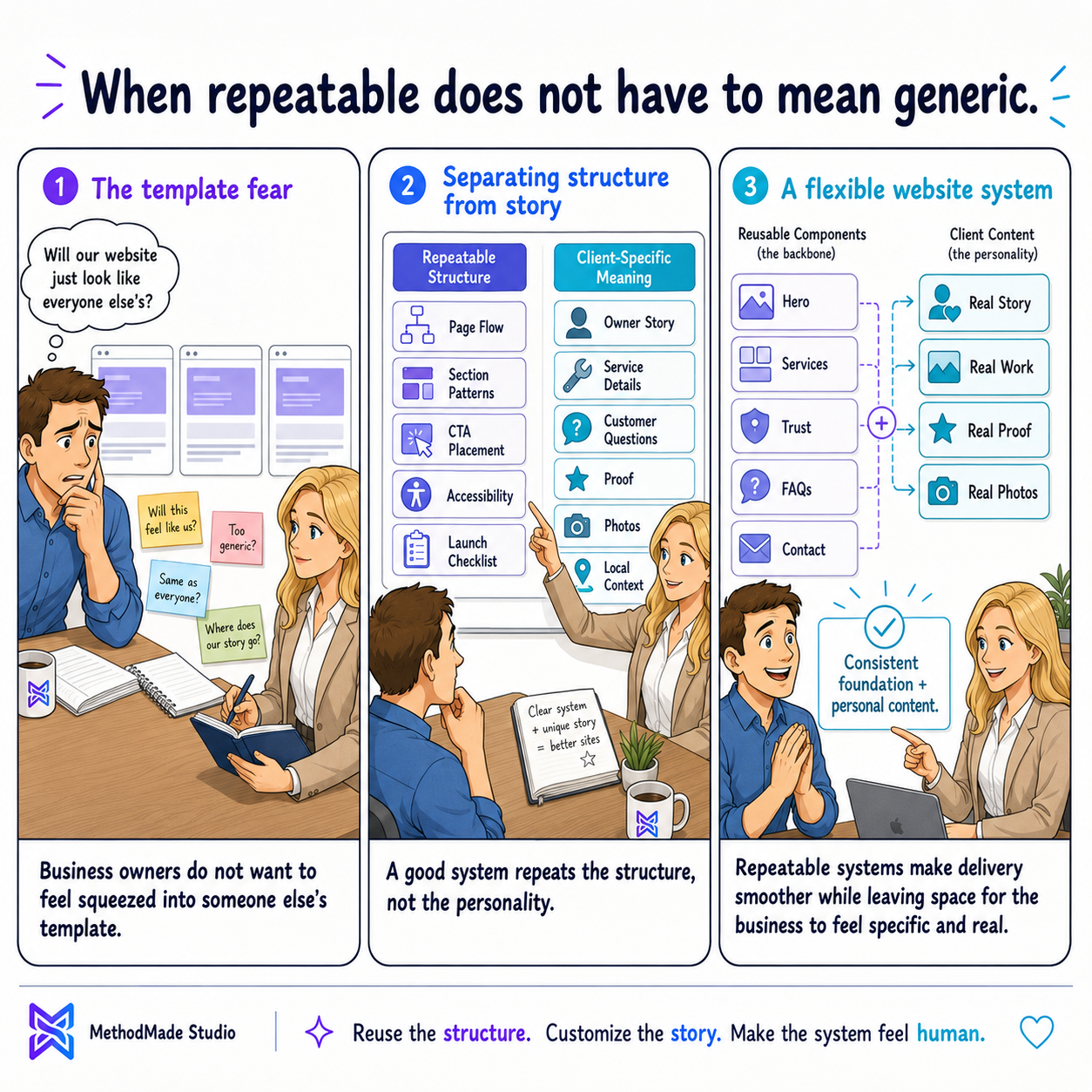
Visual guide
Repeat the system, not the client story.
Your action plan
A delivery map separating repeatable project steps from client-specific content, design, proof, customer experience, and approval decisions.
Want help applying this?
If this guide describes part of what your business is dealing with, tell us what is happening. We can decide whether there is a useful project, clarify the scope, and estimate it around the actual work involved.
A natural next step
The guide or story below builds naturally on what you just read.
Related practical guide
Audit the website before choosing the project. A cleanup may solve outdated details and broken paths; a refresh may improve content and presentation; a rebuild is justified only when the foundation cannot support what the business now needs.
Read guide →Related experience story
The problem was not a lack of effort or creativity. Long handoffs, offshore dependency, and scarce Kentico knowledge were slowing custom association websites. I redesigned the workflow so discovery, design, content, and development could move together.
Read story →Please don’t share passwords, payment details, medical information, or other sensitive data here.