
Faster website delivery without turning every client into the same template
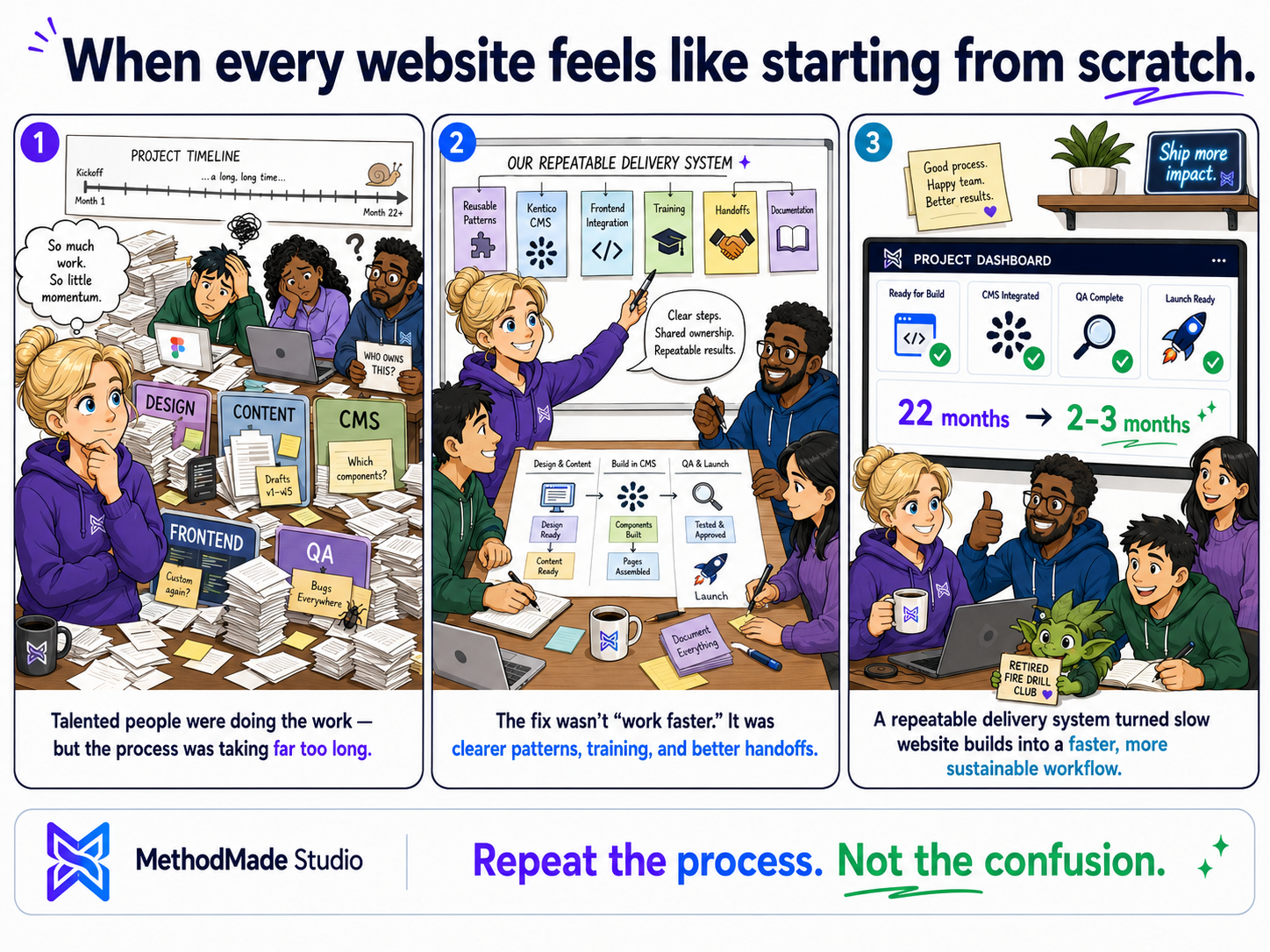
A redesigned delivery system reduced a typical 22-month discovery-to-launch cycle to roughly 2–3 months on the first site, expanded capacity, and supported at least eight distinct association launches.
22 → 2–3 months
Discovery-to-launch lifecycle
The first site delivered through the redesigned model launched in roughly two to three months instead of the prior typical timeline.
2 sites
Parallel delivery capacity
Two engineers could independently lead association sites while supporting each other through reviews and launch checks.
8+
Distinct association websites
At least eight association websites were delivered through the repeatable model before I moved into broader work.
The real situation
A custom Farm Credit association website typically took around 22 months from initial concept through launch. Each site needed its own brand, content, regional context, accessibility needs, compliance considerations, and client relationship—so flattening the work into generic templates was not an acceptable shortcut.
The delay lived in the delivery system. Discovery, design, content, and development moved through slow sequential handoffs, while technical changes depended heavily on an offshore Kentico queue.
What the business was carrying
The visible problem
- Associations waited too long to move from concept to a usable website.
- Design and content teams could not iterate quickly when every technical adjustment entered an external queue.
- Critical platform knowledge lived outside the people closest to the client and the daily work.
Why the obvious fix was not enough
The harder system underneath
- Speed could not come at the cost of each association’s identity or requirements.
- Kentico was difficult to work with, but replacing the CMS was not part of the project.
- The solution had to improve both the project workflow and the team’s long-term capability.
The delivery redesign
Work moved together instead of waiting in line
The faster model did not skip discovery or customization. It reduced idle time by connecting the people and technical work earlier.
Before
- Sequential discovery, design, content, and development
- Offshore Kentico queue
- Late technical feedback
- Typical lifecycle around 22 months
After
- First site launched in roughly 2–3 months
- Two sites could move in parallel
- At least eight distinct launches
- In-house capability and easier maintenance
- 01
Shared discovery
Define the association-specific direction
Bring relationship, content, design, and development into the same starting conversation.
- 02
Early foundation
Build scaffolding while ideas develop
Create wireframes and Kentico structure before every visual and content decision is final.
- 03
Iterate
Integrate and review continuously
Catch misunderstandings while they are still inexpensive to change.
- 04
Enable
Document and transfer ownership
Make the process teachable so capacity grows beyond one person.
What changed
Decisions that moved the work forward
- 1 Align
Start discovery together
Relationship management, design, content, and development joined the process early so the technical foundation could evolve alongside the client-specific direction.
- 2 Parallelize
Replace final handoffs with continuous integration
While design and content developed, I built wireframes, scaffolding, and the initial Kentico structure, then integrated work as it became ready.
- 3 Standardize
Reuse the avoidable work
I created adaptable hero structures, callouts, content blocks, customizable components, and raw scaffolds without standardizing the finished sites.
- 4 Transfer
Turn individual expertise into team capability
I documented the process, paired with another experienced engineer until he could own sites independently, and helped establish staff training for ongoing content work.
What the business gained
Results beyond the implementation
01
The team moved from sequential handoffs to a parallel, iterative delivery rhythm.
02
More technical capability lived in-house, reducing queue delays and improving feedback.
03
The repeatable foundation increased speed while each association website remained distinct.
What this proves for a client
The scale may change. The systems judgment still transfers.
Repeatable delivery should standardize the hidden scaffolding, not the client’s identity. MethodMade uses the same principle for smaller website systems: reuse page structures, content patterns, decision points, and quality checks so more attention can go to the parts that should be genuinely custom.
Technical footprint
Evidence and boundaries
- ✓ Typical timeline reduced from roughly 22 months to 2–3 months on the first site
- ✓ At least eight association launches
- ✓ Two engineers enabled for parallel ownership
- ✓ Kentico capability brought further in-house
Association identities, internal delivery records, exact compliance requirements, and private CMS configurations remain generalized.
Visual recap
Reusable delivery capability, distinct client outcomes.
Related practical guide
Repeatable Website Systems Without Generic Results
Read the guide →Related experience
Browse the full proof library for other systems, workflow, and delivery examples.
A practical next step
Make the website process reusable without making the website generic
We can identify where handoffs, page structures, content decisions, or platform friction are adding avoidable time.