
1
Listen
- Customer situations
- Repeated questions
- Spoken explanations
Start With What You Already Know
You do not need polished copy before a website project can begin. Use real customer situations, repeated explanations, proof, questions, and existing business material to create a clear first draft without staring at an empty document.
Content from real work
“Send me your website content” sounds simple until a business owner opens a blank document. The owner may explain the work clearly every day, but turning years of experience into polished page copy is a different task. The request quietly turns discovery, messaging, structure, editing, and proof gathering into homework. A better process begins with conversation and evidence. Start with what customers ask, what the team explains repeatedly, what the business actually does, and what proof already exists. The first draft does not need to sound impressive. It needs to be accurate, useful, and recognizable.
People understand a business more easily when it begins with the real circumstances that bring someone there—not a slogan assembled in a vacuum.
Choose three to five moments that cause someone to start looking for help. Describe what is happening, what the person is worried about, and what they need next. Ordinary language is useful here because it sounds like the customer’s actual life rather than an internal service category.
A service list may be technically accurate and still leave someone wondering which option fits. A recognizable situation gives the service meaning before the business asks the reader to understand its terminology.
Pretend a thoughtful customer asked, “What do you actually help with?” Record a short voice note or write the answer as you would naturally say it. Do not stop to make every sentence polished. Spoken explanations often contain the clearest examples, boundaries, and phrases because the owner is focused on helping someone understand rather than trying to sound marketable.
Listen for the parts that become more specific when you talk: who you help, what usually happens first, what is included, what changes timing or fit, and what someone should expect after reaching out. Those details are the raw material of useful website copy.
The website does not need content invented from nothing. It needs useful material collected from the places where the business already explains, proves, and performs the work.
For a week or two, save questions from calls, email, text messages, estimates, forms, social messages, and staff conversations. Repeated questions reveal what customers need to understand, trust, compare, or prepare for before they feel comfortable taking the next step.
Do not automatically move every question into one giant FAQ. Place the answer near the decision it supports. A question about fit belongs near the service. A question about preparation belongs near the form or booking step. A question about timing may belong in the confirmation message customers receive after they reach out.
Collect verifiable material that helps a reasonable customer feel safer making a decision. Useful proof may include current credentials, approved reviews, examples of completed work, real photographs, years of experience, response expectations, clear policies, and specific explanations of how the work is handled.
Proof becomes more useful when it supports a nearby claim. A license belongs near the service it matters to. A customer example belongs near the situation it demonstrates. A response-time expectation belongs near the contact action—not hidden on an unrelated page.
Gather service notes, FAQs, estimates, intake forms, reviews, photos, biographies, policies, current website links, account-access needs, and examples of language the owner likes or dislikes. The packet does not need to be elegant. Its purpose is to keep the project from relying on memory and scattered messages.
Mark every item as current, needs verification, private, outdated, or not for publication. That simple review prevents an old service description, expired credential, borrowed image, or internal note from quietly becoming public website content.
Content harvest
Real material
Review filter
Verify Current and accurate Protect Private or permission needed Remove Outdated or not for publicationUseful destinations
The first website draft is assembled from real business knowledge—not summoned from a blank document.
Once the raw material is visible, the next job is not to write everything at once. Decide what each page must help the visitor understand, trust, or do.
The homepage should orient the visitor and help them recognize whether they are in the right place. Service pages should explain fit, scope, process, proof, and the next step. The About page should make the business credible and human. Contact or booking pages should reduce uncertainty about what the visitor is starting and what happens afterward.
This prevents the common problem where every page repeats the same vague introduction while the useful details remain buried in one long document or missing entirely.
Before writing a full homepage, create one short explanation that names who the business helps, the situations it handles, what it does, what makes the approach dependable, and what the reader should do next. That paragraph becomes a reference point for the rest of the site.
Avoid claims such as “quality service,” “innovative solutions,” or “customer-focused excellence” unless the surrounding copy shows what those words mean in practice. A specific process, clear boundary, real example, or honest expectation usually communicates more than a polished generality.
The content packet will not answer everything, and it should not pretend to. Missing information may reveal a decision the business has never made, a service nobody has clearly defined, proof that needs permission, or a customer expectation that varies depending on who answers.
List those gaps and bring them into the next conversation. A visible unanswered question is healthier than confident copy built on an assumption.
Clear editing should make the owner easier to understand without replacing their personality or exposing information that never belonged in a shared draft.
Keep natural phrases the owner actually uses—especially when they explain a difficult idea simply, describe why a boundary exists, or tell a story that makes the work understandable. Remove filler, repetition, jargon, and exaggerated promises, but do not replace every recognizable sentence with generic marketing language.
The finished copy should sound like the business on a clear, thoughtful day. It does not need to sound like a different company with a larger thesaurus.
Do not place passwords, private customer details, employee information, confidential pricing logic, legal material, medical information, payment data, or internal records into shared drafts or AI tools without appropriate permission and protection. Remove identifying details when an example can teach the same lesson anonymously.
Content gathering should make business knowledge easier to use—not create a new privacy or security problem. When in doubt, preserve the lesson and leave the identifying detail out.
Visual guide
You do not need perfect copy. You need a clearer way to explain what customers already ask.
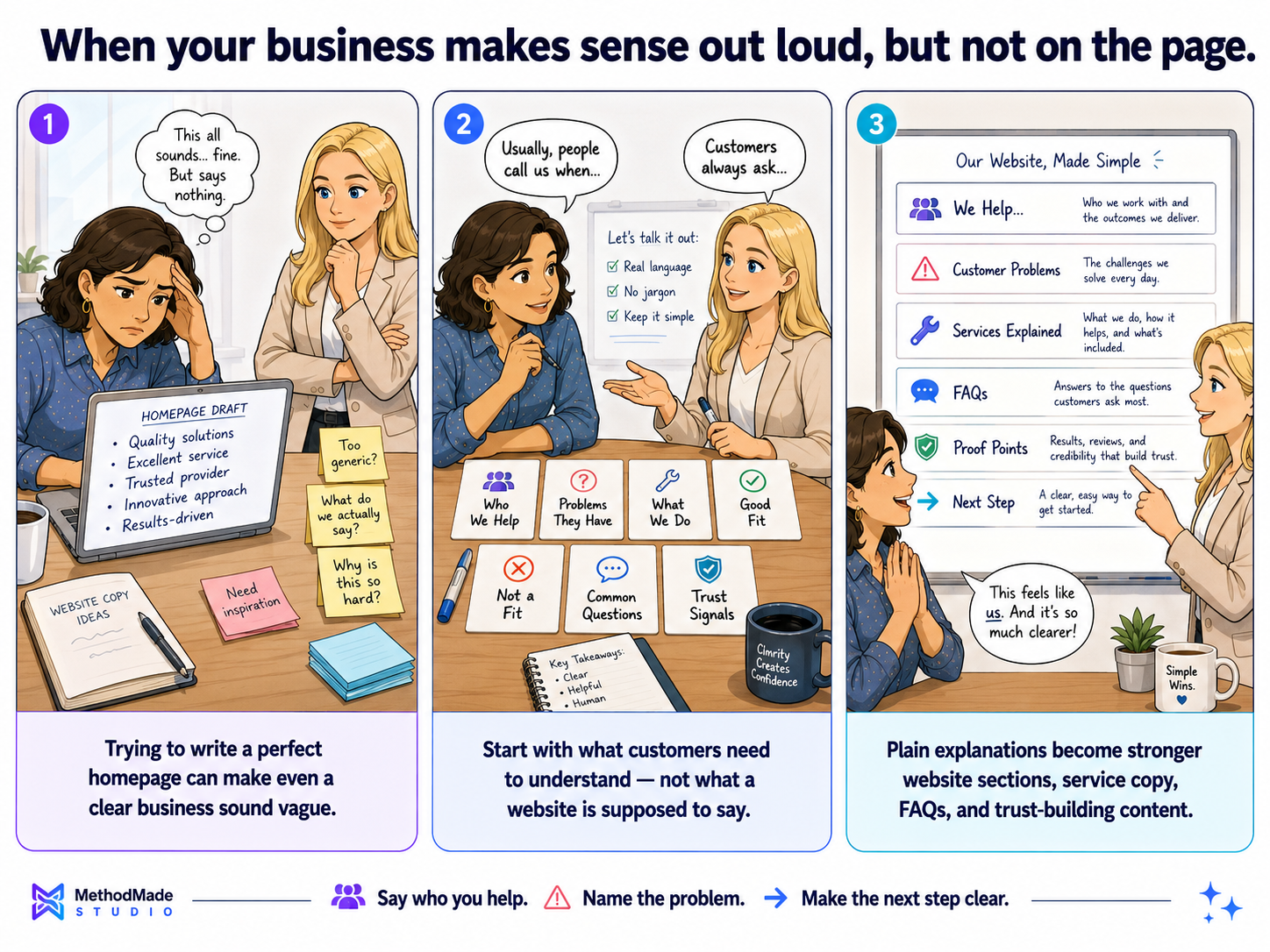
Your action plan
A practical content packet with a business explanation, customer situations, service notes, proof, repeated questions, images, access needs, and a list of remaining gaps.
Want help applying this?
If this guide describes part of what your business is dealing with, tell us what is happening. We can decide whether there is a useful project, clarify the scope, and estimate it around the actual work involved.
A natural next step
The guide or story below builds naturally on what you just read.
Related practical guide
A website can load correctly and still create hesitation, wrong-fit inquiries, repeated questions, and uncertain next steps. Use real customer confusion to find the pages, language, proof, or expectations that need repair.
Read guide →Related experience story
The problem was not a lack of effort or creativity. Long handoffs, offshore dependency, and scarce Kentico knowledge were slowing custom association websites. I redesigned the workflow so discovery, design, content, and development could move together.
Read story →Please don’t share passwords, payment details, medical information, or other sensitive data here.