
1
Simpler
- Remove work
- Clarify the process
- Use a checklist
Tool Decision Guide
Before buying software or building something custom, examine one repeated process closely. Measure the time and trouble it creates, separate routine steps from human judgment, and compare the least complicated fixes.
Six-fix ladder
Every week, someone copies the same customer details into another file, checks three places for status, prepares the same document, or sends another reminder. That may be reasonable. It may need a checklist, a better spreadsheet, an existing product, automation, or a focused internal tool. The goal is not to prove the business needs software. It is to find the least complicated change that removes enough real trouble to be worth adopting and maintaining.
A useful decision begins with one process that has a recognizable starting point, a visible ending, and enough real examples to show how it behaves.
“Improve operations” is too broad. Choose one repeated path, such as preparing an estimate, assigning a request, updating inventory, scheduling work, or producing a weekly report. Write what starts it and what should be true when it is complete.
Clear boundaries keep the review from turning into a complaint list about every tool and habit in the business.
Record frequency, elapsed time, active work time, people involved, tools used, waiting, copying, missing information, corrections, and consequences. Include ordinary examples and the awkward ones people usually work around quietly.
The point is to distinguish a repeated business problem from an occasional inconvenience that does not justify new software.
Software cannot reliably repair ownership, definitions, or decisions the team has never made explicit.
Ask two people to describe the work and compare their answers. Look for differences in ownership, status meanings, required information, completion rules, and what happens when the normal path does not fit.
When the process changes depending on who performs it, the first improvement may be a shared definition or handoff rather than a product purchase.
Repeated copying, formatting, reminders, routing, and status updates may be supported by a tool. Fit decisions, complaints, pricing exceptions, sensitive approvals, safety concerns, and unusual situations still need visible human responsibility.
The best tool usually removes predictable setup work while leaving consequential decisions with the person accountable for them.
Count time, errors, delays, rework, risk, attention, and missed opportunities. One serious source of delay or risk may matter more than dozens of tiny annoyances.
Write what should improve if the process changes. Without that measure, it is easy to buy a tool and later discover that the team is doing the same work in a different interface.
Solution staircase
Stop climbing when a lower step solves the measurable problem responsibly.
The right answer may be smaller than software—and when software is justified, the full cost extends far beyond the purchase price.
Do not jump from annoyance to custom application. Compare each option against the evidence and stop when a simpler change solves the meaningful problem.
Include setup, data cleanup, integration, training, documentation, permissions, subscriptions, testing, maintenance, support, privacy review, correction time, outages, and future ownership.
A tool that saves ten minutes but creates a permanent maintenance obligation may not be the improvement it first appears to be.
A contained first version should reduce one measurable burden, preserve human judgment, and teach the business what it actually needs next.
Name the repeated burden it must reduce, who uses it, what starts it, what information it needs, which decisions remain human, how unusual cases are handled, and how the business will know it helped.
A useful first version might create a visible task from a complete request, prepare a document draft, reduce duplicate entry, or show one dependable status. It does not need to rebuild the entire operation.
The answer may be keep manual, improve the handoff, use a tool already owned, test one automation, compare products, or explore a focused build. Record the evidence, owner, expected result, and what would cause the decision to change.
A review date prevents a temporary workaround from quietly becoming permanent and prevents a new tool from surviving merely because the business already paid for it.
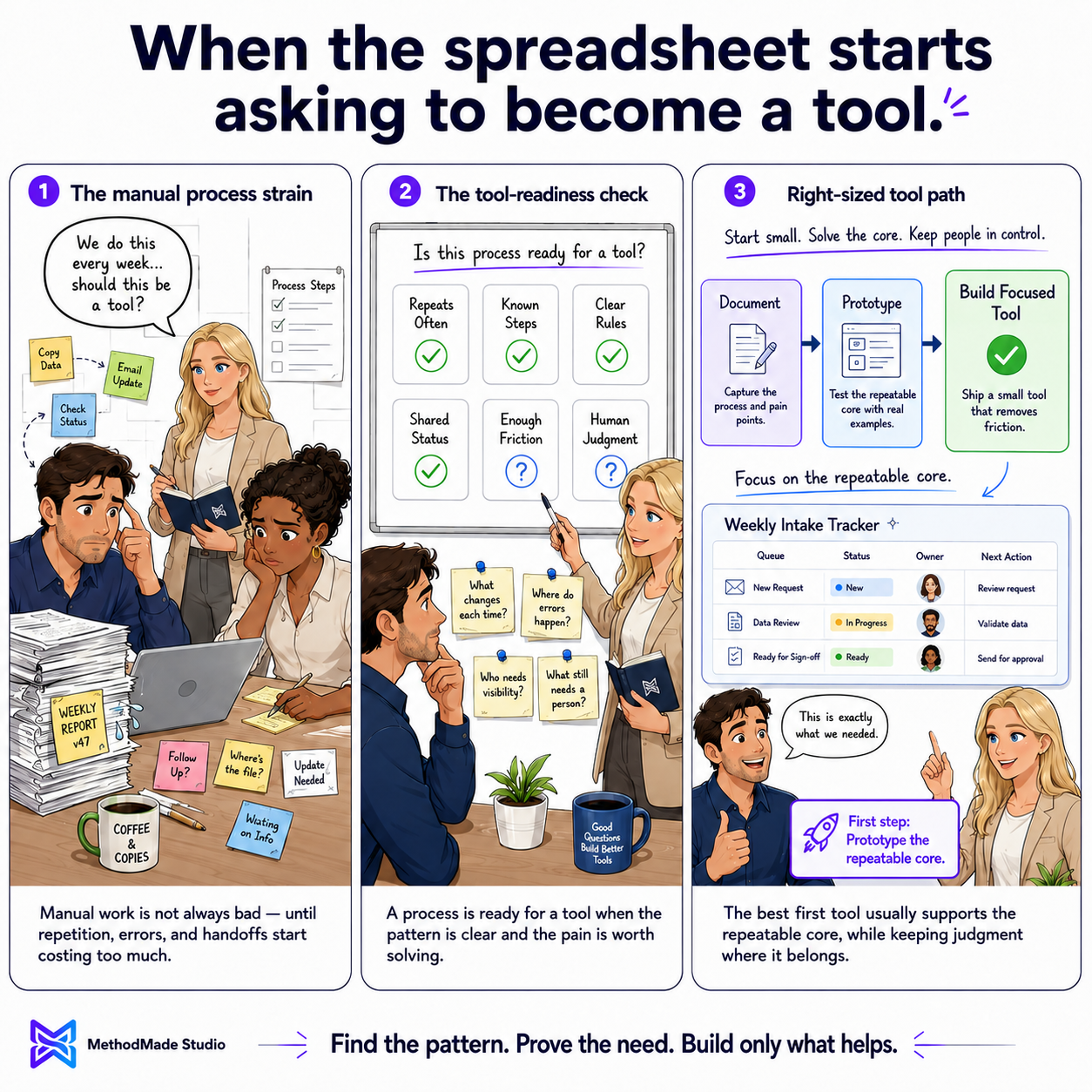
Visual guide
A manual process is tool-ready when the repeated parts are clear.
Your action plan
A one-page decision showing the current process, measurable trouble, human decisions, unusual cases, six possible fixes, and the smallest sensible first step.
Want help applying this?
If this guide describes part of what your business is dealing with, tell us what is happening. We can decide whether there is a useful project, clarify the scope, and estimate it around the actual work involved.
A natural next step
The guide or story below builds naturally on what you just read.
Related practical guide
Before connecting tools or adding AI, explain the real process, write the handoff, identify human decisions and unusual cases, and test whether one repeated task is clear enough to automate safely.
Read guide →Related experience story
A spreadsheet-based workaround had become a recurring operational dependency. I turned the real process underneath it into a searchable internal application that preserved existing work and removed approximately 295 hours of manual entry each month.
Read story →Please don’t share passwords, payment details, medical information, or other sensitive data here.