
1
Rescue
- Working / fragile / broken
- Risky unknowns
- Keep / fix / finish / pause
Project Rescue And Safe Change
Whether a project is half-built or a live system must move, begin with a trustworthy current state. Protect critical customer and business paths, reduce unknowns, choose the smallest safe scope, test in stages, and preserve a recovery path.
Two paths, one safety plan
Some projects are trapped in an uncomfortable middle: too much has been invested to walk away casually, but the work is not dependable enough to continue with confidence. Other systems are already live and must change while customers and employees continue using them. These situations are different, but they share a safety rule: do not make major changes until the team understands what exists, what people depend on, what could break, and how to recover.
A rescue, a live transition, and a high-trust system change require different emphasis. All three begin with an honest current state and a clear business need.
A rescue begins with unfinished, broken, unknown, or vendor-abandoned work. A live change begins with a functioning system that must move, modernize, or replace part of its foundation while people continue depending on it. A high-trust change adds stronger expectations for accessibility, privacy, language, continuity, and care.
Choose the primary path even when elements overlap. That decision shapes the risks, testing, communication, and recovery plan that deserve the most attention.
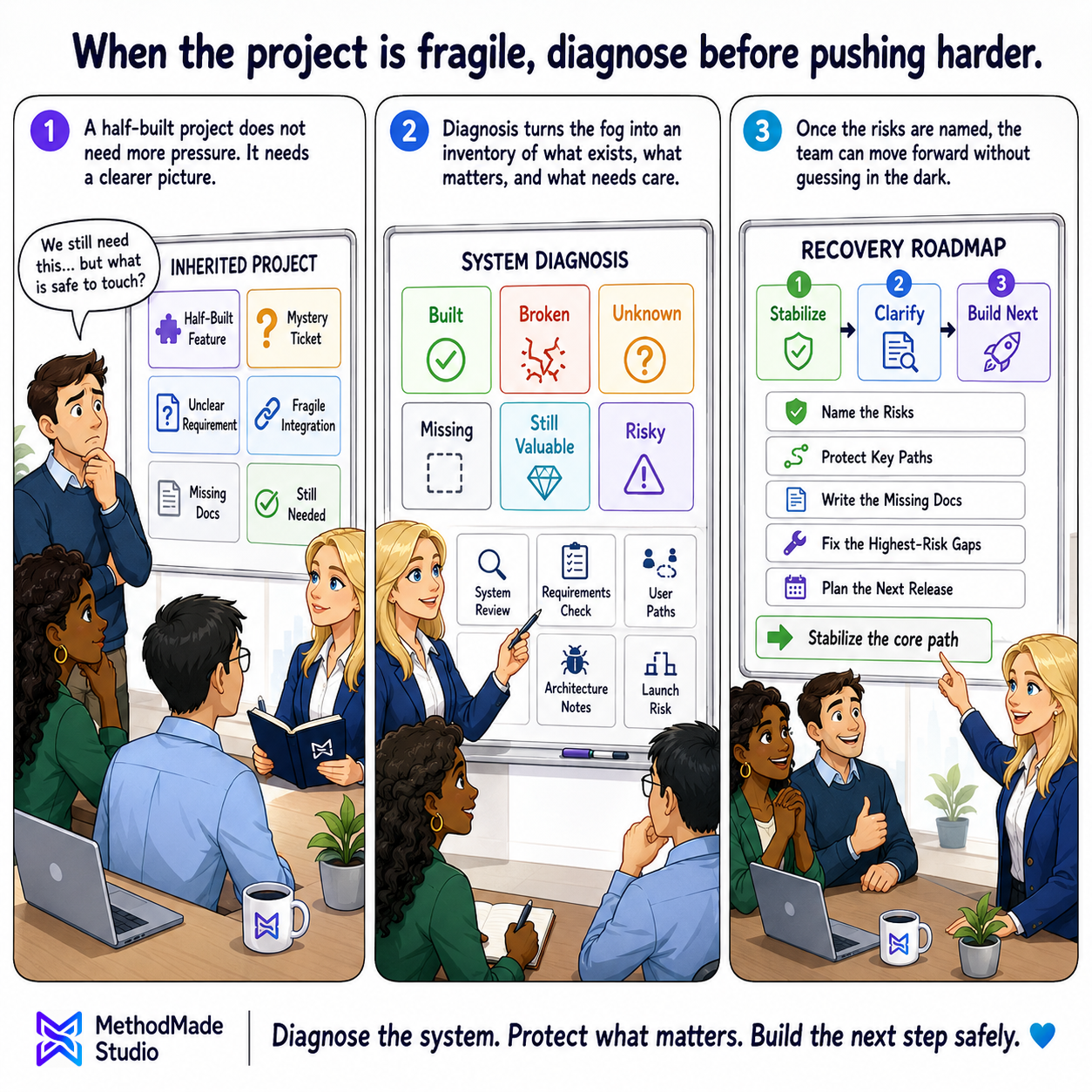
Open the system and examine what can actually be used today. Separate working, fragile, broken, unknown, and missing. Use demonstrations, logs, records, source access, and representative data instead of relying on estimates of how close the project is to completion.
This is not a blame exercise. It is a way to stop planning around assumptions that may no longer be true.
Write the result the business still needs in plain language. Identify who depends on it, what they must be able to do, what must remain available during change, and which old ideas no longer matter.
A half-built feature should not survive merely because time was already spent on it. The question is whether it still supports a dependable result people need now.
Not every feature carries the same consequence. Focus investigation and protection on the customer, operational, and data paths whose failure would create real harm or disruption.
Identify customer access, authentication, payments, forms, essential data, scheduled work, notifications, staff operations, accessibility needs, support routes, and recovery steps. Write which paths must remain available and which can tolerate a planned pause.
This list prevents the team from treating a cosmetic feature and a payment, identity, or customer-record path as though they carry equal risk.
Prioritize questions about ownership, source access, exports, backups, supported technology, data quality, third-party dependencies, privacy, permissions, and maintainability. Each investigation should end with a decision, not merely produce another technical document.
The useful question is whether the unknown changes safety, feasibility, cost, sequence, or the responsible scope of the next phase.
Use keep, fix, finish, pause, and remove. Keep what is dependable and still useful. Fix what blocks a critical path. Finish only what is necessary for the smallest complete result. Pause ideas that are valuable but not safe or necessary now. Remove work that creates more risk than value.
“Already paid for” is not enough reason to preserve something the business cannot safely operate or maintain.
Safe change flight plan
Small scope should remove unnecessary work—not testing, ownership, accessibility, privacy, documentation, or recovery.
Choose the smallest useful version or move that completes a real customer or business path. A rescue may finish one dependable workflow. A live transition may move one well-understood service or group of users before expanding.
Avoid a thin slice that appears small only because it pushes testing, monitoring, support, or recovery into an undefined future.
Verify critical paths, permissions, integrations, accessibility, data quality, and unusual cases. Rehearse the transition, define cutover timing, monitor results, and keep rollback or recovery available before the live move.
Use working demonstrations and staged reviews rather than a dramatic final reveal. Each stage should answer whether the next expansion is still responsible.
When people are grieving, vulnerable, seeking public services, managing health or financial concerns, or sharing sensitive information, reliability is part of the experience. Review language, accessibility, privacy, failure messages, response paths, and how a person recovers from a mistake.
The system should not make a difficult human moment harder merely because the technical happy path was completed.
A safe plan names who makes decisions, who watches the change, how people learn what is happening, and which conditions require a pause or a different approach.
Every material risk, open question, test, approval, incident, and next step needs a current owner. Keep status in a shared project record rather than allowing side conversations to become the only history of why a decision was made.
Communicate what is working, what remains uncertain, what changed, and what users or staff should expect. Clear communication is part of operational safety.
Pause, partially replace, or stop when ownership cannot be established, information cannot be trusted or recovered, unsupported technology creates unacceptable risk, privacy or accessibility cannot be corrected responsibly, or repair costs more than replacing the risky portion.
Stopping is not failure when continuing would create more harm, cost, or fragility. A responsible plan preserves the option to become less wrong before the situation becomes harder to reverse.
Visual guide
A fragile project needs diagnosis before more pressure.
Your action plan
A current-state map, critical-path list, risk register, keep/fix/finish/pause/remove decision, staged change plan, review owners, and recovery plan.
Want help applying this?
If this guide describes part of what your business is dealing with, tell us what is happening. We can decide whether there is a useful project, clarify the scope, and estimate it around the actual work involved.
A natural next step
The guide or story below builds naturally on what you just read.
Please don’t share passwords, payment details, medical information, or other sensitive data here.