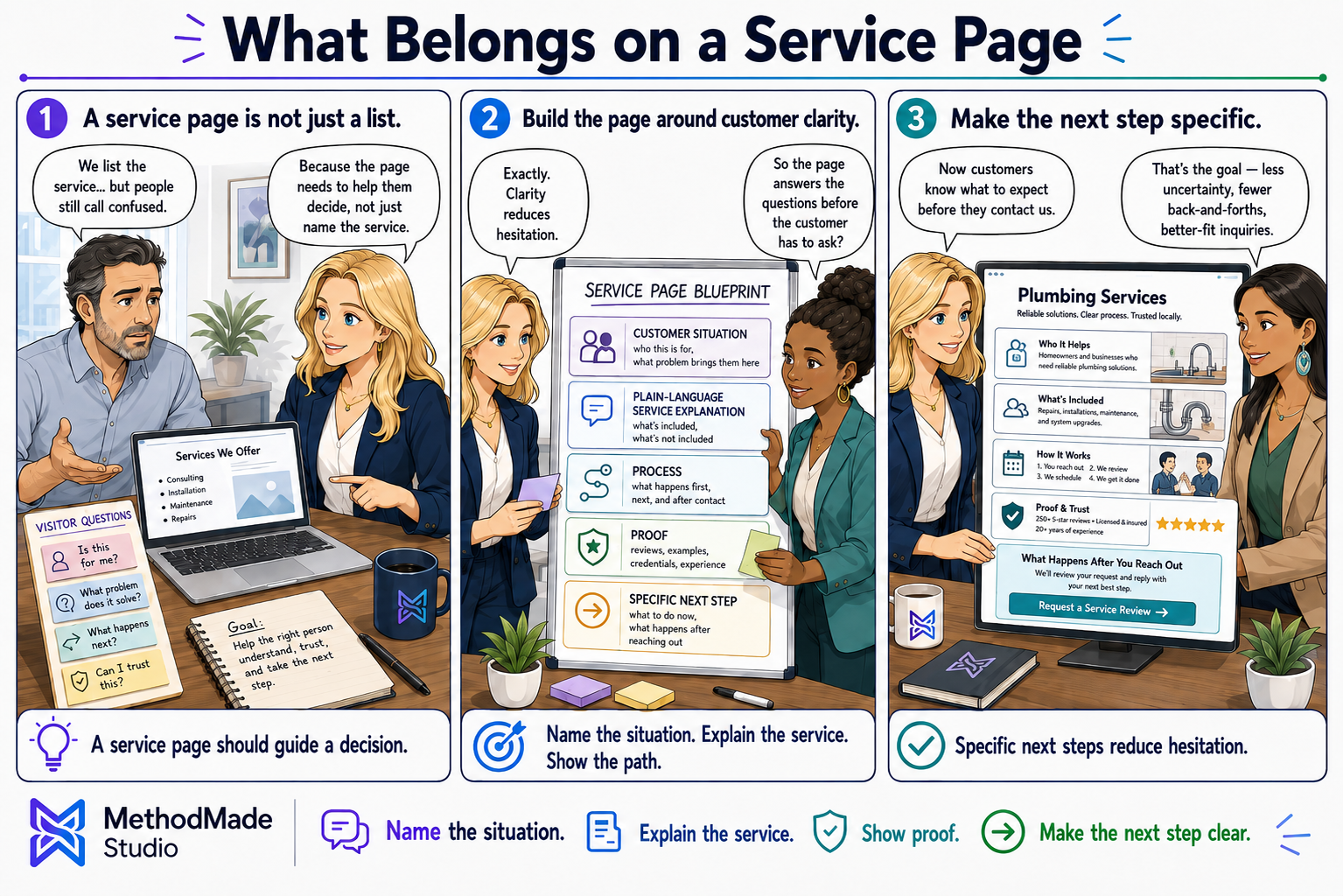
A service page is not just a menu item. It is a decision page. Someone landed there because they are trying to understand whether this service solves their problem, whether the business is credible, what the process looks like, and what they should do next. A page that only lists the service name leaves the customer doing too much of the decision work.
Start with the customer situation
Before describing the service, name the situation that causes someone to need it. People often recognize their own problem before they understand the service category.
This helps the page feel less like a brochure and more like a useful guide for deciding whether to take the next step.
- ✓What problem brings someone here?
- ✓What are they worried about?
- ✓What have they already tried?
- ✓What does a good-fit customer look like?
- ✓Who is not a fit for this service?
Explain the service in plain language
A service page should explain what the service includes, what it does not include, what decisions may affect scope, and what the customer should expect. Specific language is usually more useful than broad claims about quality or excellence.
Plain language does not make the business sound less professional. It makes the business easier to trust.
Show proof where it supports the decision
Proof can be reviews, examples, photos, credentials, process clarity, years of experience, repeat customers, owner involvement, or thoughtful explanations. The point is not to stuff the page with every trust signal. The point is to place proof near the decision it supports.
If someone worries whether the business can handle a specific type of work, show proof that answers that concern.
Make the next step specific
A service page should not end with a vague “Contact us” if the customer still does not know what contact means. Explain what happens after they reach out, what information helps, how soon to expect a response, and what the business will do with the request.
Clear next steps reduce hesitation and reduce back-and-forth for the team.