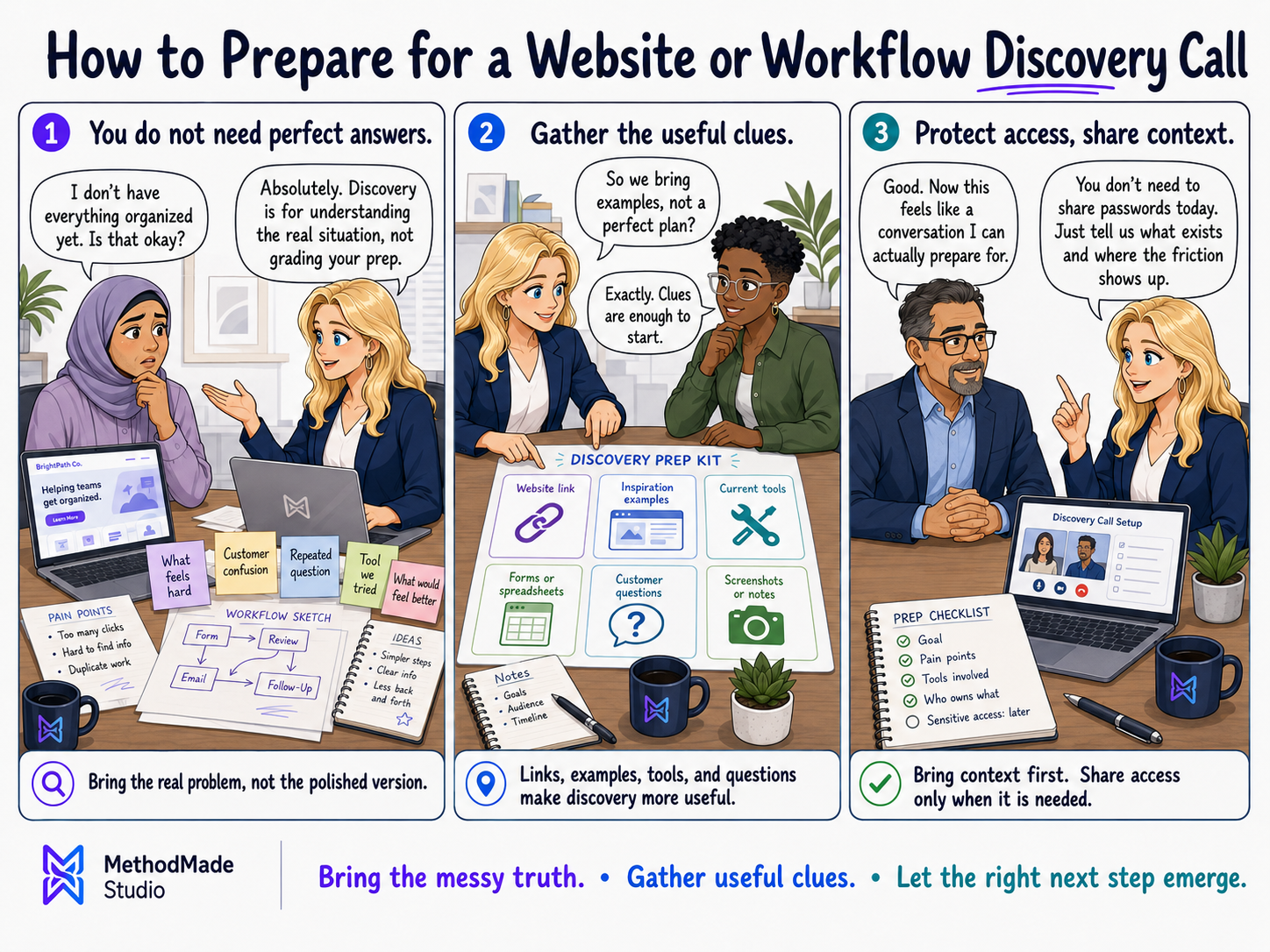
A good discovery call should not feel like a test. You do not need perfect copy, polished diagrams, or a complete technical plan. The point is to bring enough real context to understand the project clearly: what is happening now, what feels hard, what customers need, what tools are involved, and what outcome would actually help.
Bring the real problem, not the polished version
Discovery works best when the messy version is allowed into the room. The workaround, repeated question, confusing handoff, abandoned tool, awkward spreadsheet, or vague website page may be the exact clue that points to the right project scope.
Trying to make everything sound neat too early can hide the problem that most needs attention, especially when the real issue lives in a workaround, handoff, or repeated question.
- ✓What feels harder than it should?
- ✓Where do customers or staff get confused?
- ✓What work depends on memory?
- ✓What have you already tried?
- ✓What would feel noticeably better?
Gather links, examples, and tools
Helpful discovery materials include the current website, inspiration links, competitor examples, Google Business Profile, social pages, forms, spreadsheets, CRM screenshots, email templates, intake questions, repeated customer questions, and any tools involved in the workflow.
You do not need to share sensitive access during the first call. It is enough to know what exists, who owns it, and where the friction appears.
Collect customer questions and repeated explanations
The questions customers ask are often more useful than a formal marketing brief. They reveal what people need to understand before they trust the business or take the next step.
Bring the explanations you repeat most often. Those can become website sections, FAQs, intake guidance, confirmation messages, or workflow documentation.
Name constraints early
Budget, timing, access, approvals, maintenance capacity, team availability, and must-have features all affect scope. Naming constraints early makes the project safer, not smaller.
Good scope comes from matching the work to the real situation instead of pretending every project has unlimited time, money, and clarity.