
1
Receive
- All supported channels
- Useful information
- Clear confirmation
From Submission To Next Step
A form collects information; a working system makes the request visible, confirms receipt, assigns ownership, tracks status, prompts follow-up, and recovers when the normal path breaks.
Complete request loop
Many businesses improve a form and assume the intake problem is solved. The form may collect perfect information while the request still disappears into an inbox, waits for the wrong person, or receives inconsistent follow-up. The useful system begins before the form and continues until the request is closed, scheduled, declined, or moved into ongoing work.
Customers may reach out in different ways, but the business needs one dependable place where each request becomes visible and receives a next step.
Include website forms, direct email, phone calls, text messages, social messages, referrals, booking tools, and in-person notes. Decide which channels the business actively supports and how each one enters the shared process.
The goal is not to force every customer through the same door. It is to prevent requests from living only on one person’s phone, inbox, or memory.
Ask for the details needed to understand, route, and respond to the request—not everything the business might someday want. Extra questions create friction and can collect private information before it is actually necessary.
Explain why sensitive details are requested and avoid using insecure channels for information that needs stronger protection.
A request should reassure the customer and create visible responsibility inside the business at the same time.
Tell the customer that the request was received, what usually happens next, the expected response window, and what to do if the matter is urgent. A useful confirmation reduces uncertainty instead of merely displaying a generic thank-you message.
Test the internal side too. The team should receive enough context to respond without opening several systems or asking the customer to repeat information they already supplied.
Define who sees the request first, who is responsible for the next action, how ownership changes, and what happens when the usual person is unavailable. Shared visibility is helpful; shared responsibility without one owner is usually not.
Overdue work should become visible before the customer has to ask whether anyone received the request.
The team should be able to understand what happened, what is waiting, and what must happen next without reconstructing the story from several channels.
Statuses should describe where the request is and what is needed next. Avoid creating so many labels that people interpret them differently or stop updating them.
Keep customer details, the original request, important decisions, promises, dates, last contact, and next action together enough that another responsible person can continue the work.
This does not require a giant customer-management platform. It requires a dependable place the team actually checks and understands.
Decide when reminders occur, who receives them, what communication is appropriate, when a request is escalated, and when it is closed. Follow-up is not endless chasing; it is a visible rule with a clear stopping point.
The rhythm should match the situation. A quote request, complaint, urgent service need, and long-term sales opportunity may require different timing and tone.
Request loop
A dependable system does not hide unusual cases. It gives them a safe route to a person and learns from what keeps going wrong.
Plan for duplicates, missing information, urgent requests, wrong-fit inquiries, complaints, tool outages, and customers who use several channels. These cases should pause, flag, or route to a person rather than disappear or receive an inappropriate automatic response.
Track the next twenty requests. Measure time to first response, missing information, requests without owners, overdue next actions, repeated customer questions, and where the team still has to search for context.
Use the evidence to improve the weakest step first. A small dependable path is more useful than a complicated system nobody consistently maintains.
Visual guide
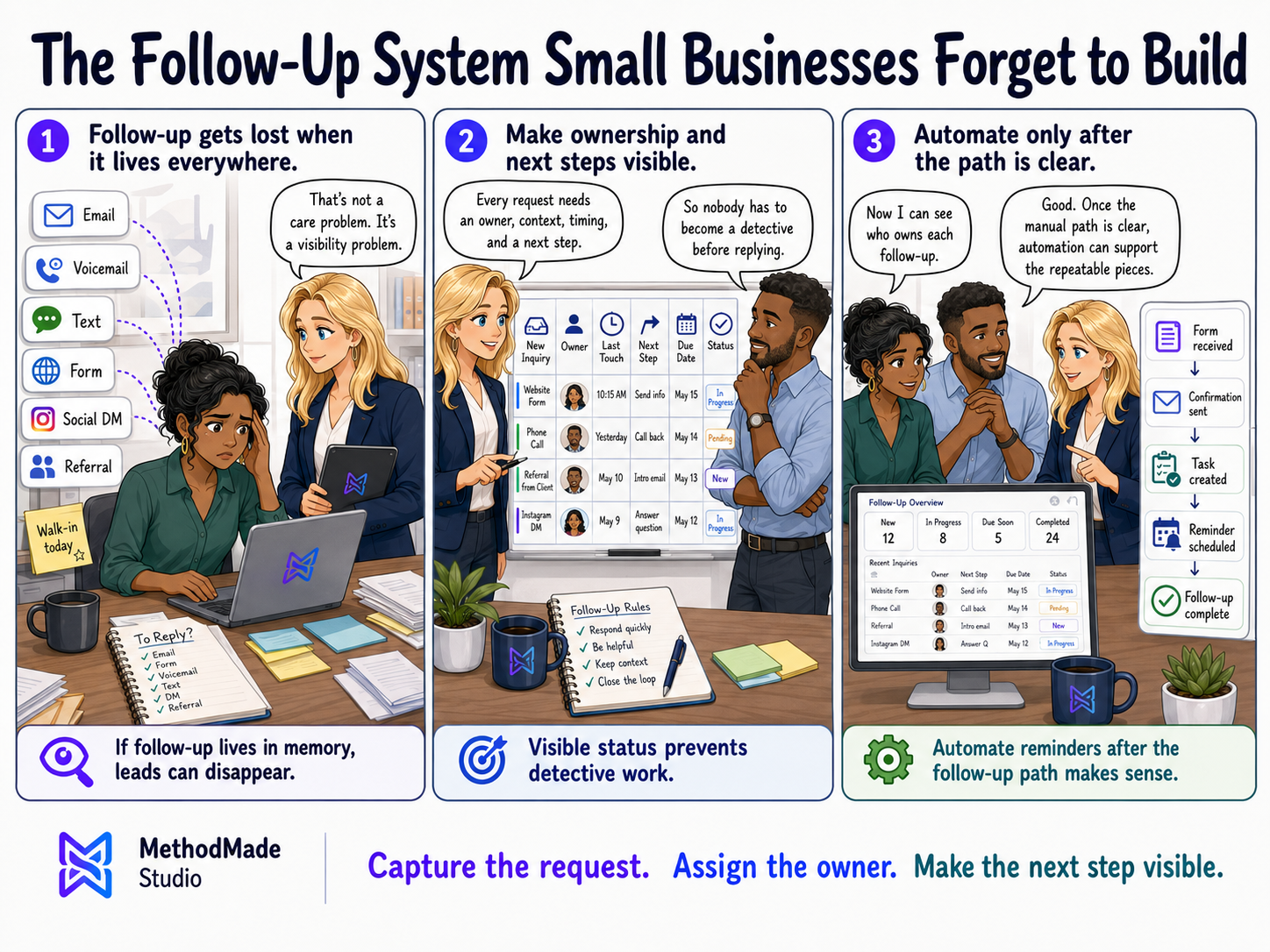
Capture the request. Assign the owner. Make the next step visible.
Your action plan
An intake-to-follow-up map with channels, required information, confirmation, owner, status, next action, timing, and recovery.
Want help applying this?
If this guide describes part of what your business is dealing with, tell us what is happening. We can decide whether there is a useful project, clarify the scope, and estimate it around the actual work involved.
A natural next step
The guide or story below builds naturally on what you just read.
Related practical guide
A spreadsheet can be the right tool and still need more care once the business depends on it. Answer seven plain questions to decide whether to keep it, tidy it up, connect it to other tools, or begin planning a replacement.
Read guide →Related experience story
A spreadsheet-based workaround had become a recurring operational dependency. I turned the real process underneath it into a searchable internal application that preserved existing work and removed approximately 295 hours of manual entry each month.
Read story →Please don’t share passwords, payment details, medical information, or other sensitive data here.