
Change the foundation without making customers feel the move
A live rewards platform moved from Create React App and Heroku to Next.js and Vercel before a fixed deprecation deadline—with no downtime or known launch defects.
0
Known launch defects
The migration reached production with zero known defects at launch.
No downtime
Customer disruption
Thousands of daily users retained access throughout the cutover.
≈ 30%
Delivery velocity improvement
Team delivery velocity improved by approximately 30% during my tenure.
6 months
Hard delivery window
The migration completed before the existing deployment path expired.
The real situation
Thousands of people used the live rewards product every day, and its Create React App deployment path on Heroku was being retired within months. This was not modernization for its own sake. It was a business-continuity problem with a fixed deadline.
I was new to the company and learning Vercel while leading a small product team. Before changing the foundation, I needed a trustworthy map of the React application, Django services, AWS infrastructure, integrations, environments, and deployment dependencies.
What the business was carrying
The visible problem
- A load-bearing deployment path had a six-month expiration window.
- The product supported daily transactional rewards activity for thousands of users.
- The team still carried normal product work while the migration had to progress.
Why the obvious fix was not enough
The harder system underneath
- The frontend depended on backend services, infrastructure, external integrations, and environment configuration that could not be treated separately.
- A successful deploy was not enough; users needed to retain access throughout the cutover.
- Because I was learning the destination platform, preparation had to replace false confidence.
The risk-reduction path
Launch day became verification because uncertainty was reduced beforehand
The migration plan treated the production environment as a connected system and pushed discovery into staging, rehearsal, backups, and rollback planning.
Before
- Expiring deployment path
- Thousands of daily users
- Unfamiliar connected environment
- Small team with concurrent product work
After
- No downtime
- Zero known launch defects
- Deadline met
- More consistent platform foundation
- 01
Map
Understand every dependency
Connect frontend, backend, infrastructure, integrations, and environments.
- 02
Rehearse
Build production-like validation paths
Use staging, test environments, temporary routing, backups, and failure scenarios.
- 03
Prepare
Document rollback and cutover controls
Know how to stop, reverse, and validate before touching production.
- 04
Launch
Change DNS and verify behavior
Use a low-traffic window, API monitoring, and Customer Success feedback.
What changed
Decisions that moved the work forward
- 1 Map
Build a dependable model of the production system
I identified where the application, Django services, AWS components, integrations, configuration, and deployment responsibilities lived.
- 2 Rehearse
Make dangerous work happen before launch
I created staging and test environments, researched each step, used a temporary subdomain, backed up databases, and documented rollback procedures.
- 3 Time
Choose the lowest-risk launch window
Product analytics identified a low-traffic period so the final cutover would affect the smallest possible number of users.
- 4 Verify
Monitor both systems and real user experience
After controlled DNS and environment changes, I monitored API logs and coordinated with Customer Success to catch issues telemetry alone might miss.
What the business gained
Results beyond the implementation
01
The live product moved to a more consistent and maintainable foundation before the deadline.
02
Users retained access and did not experience a service interruption during the cutover.
03
The team gained stronger deployment confidence and a clearer path for future product work.
What this proves for a client
The scale may change. The systems judgment still transfers.
The visible launch should be the least dramatic part of a risky migration. MethodMade’s approach is to make dependencies visible, rehearse the change, prepare rollback paths, choose timing deliberately, and turn production cutover into confirmation rather than discovery.
Technical footprint
Evidence and boundaries
- ✓ Create React App and Heroku to Next.js and Vercel
- ✓ No downtime
- ✓ Zero known launch defects
- ✓ Thousands of daily users
- ✓ Six-month deadline
Private infrastructure, account, customer, personnel, and deployment details remain generalized or excluded.
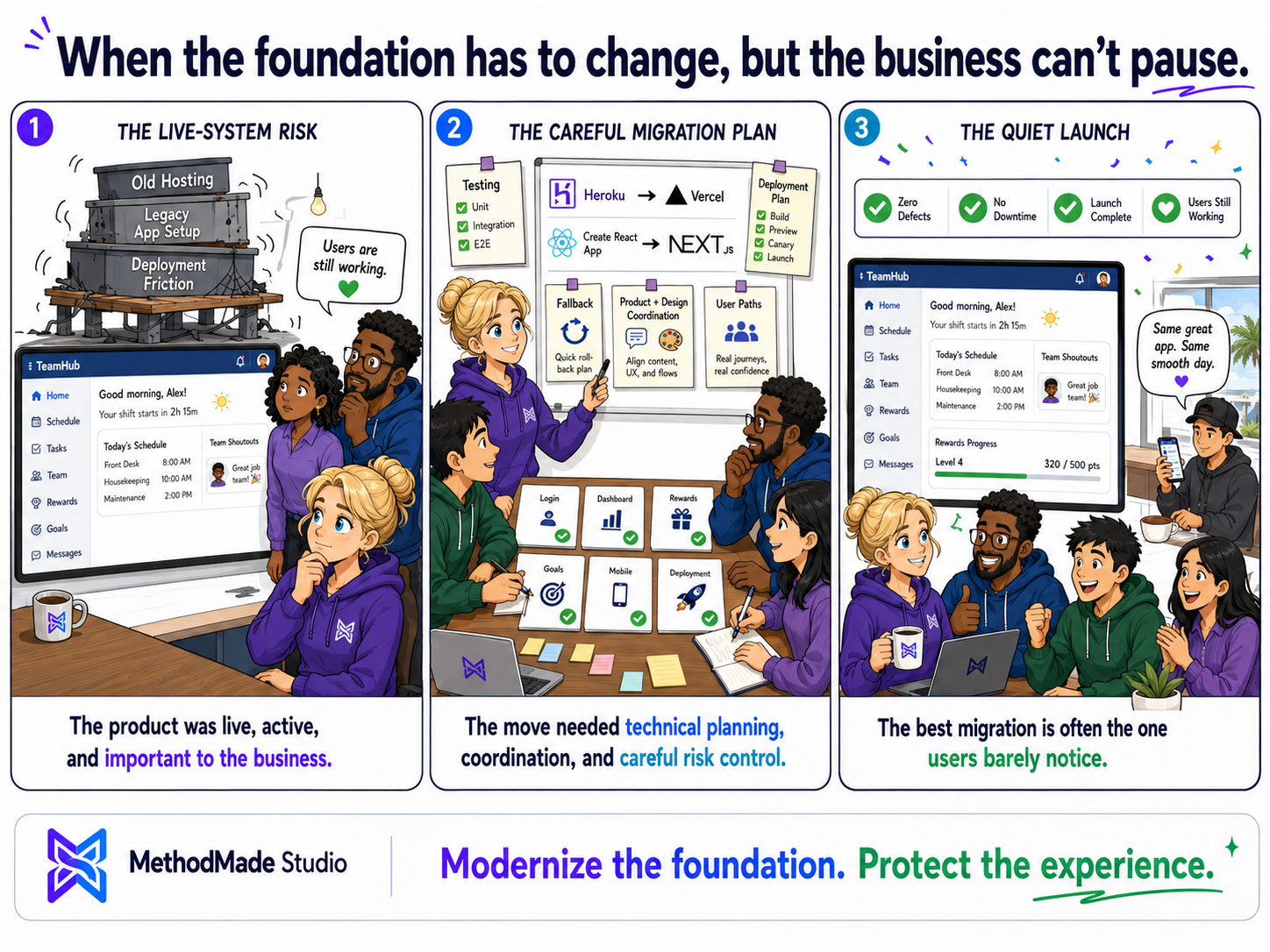
Visual recap
A better foundation, without making users feel the move.
Related practical guide
How to Move a Live System Without Chaos
Read the guide →A practical next step
Plan the migration before the deadline becomes the plan
A dependency and risk review can expose what must be rehearsed, protected, or decoupled before production changes begin.