
Take an evolving operational idea from paper sketches to production
Over nine months, an undefined client request became a complete production operations platform with workflows, permissions, integrations, testing, remote rollout, training, and handoff.
9 months
Concept to production
The platform moved from initial stakeholder meetings and paper models to a live operational system.
1 developer
Initial product ownership
I designed and built the complete first production release across discovery, architecture, frontend, backend, testing, and deployment.
30 days
Live launch support
I supported the platform through its first month until it became part of normal operations.
The real situation
The project began with a client request and evolving stakeholder conversations rather than a settled product definition. The casino needed one accountable system connecting customer kiosks, employee tablets, vouchers, gaming activity, permissions, financial actions, reporting, and operational history.
Because I developed and launched the platform remotely, I could not rely on being physically present to explain or repair every problem. Observability, guided testing, documentation, permissions, and production visibility had to be part of the product from the beginning.
What the business was carrying
The visible problem
- No existing product matched the combined operational workflows.
- Requirements continued to emerge as stakeholders saw the system take shape.
- Hardware-assisted voucher activity, gaming-system data, employee actions, and financial records needed clear traceability.
Why the obvious fix was not enough
The harder system underneath
- The scope could not be frozen honestly, so the architecture needed to absorb evolving requirements.
- Third-party documentation did not always match real integration behavior.
- Remote launch and physical testing required the system and procedures to explain themselves.
Concept to operations
The product grew through visible models, modular delivery, and real operational feedback
The system did not begin as a tidy specification. Paper models and iterative stakeholder review created enough structure to build while the business understanding continued to deepen.
Before
- Broad client request
- No settled specification
- Evolving workflows and integrations
- Remote implementation constraints
After
- Production platform in nine months
- Complete initial product built by one developer
- First 30 days supported live
- Documented transition to the next team
- 01
Discover
Map people, actions, data, and accountability
Use sketches and flowcharts to expose the real operating model.
- 02
Implement
Build modular operational capabilities
Connect vouchers, users, permissions, transactions, reporting, and external data.
- 03
Validate
Test software and physical workflow together
Guide staff through device actions and expected results remotely.
- 04
Operate
Support production and transfer ownership
Resolve launch issues, document the system, train users, and hand off to the next team.
What changed
Decisions that moved the work forward
- 1 Model
Make the business visible before coding it
I used paper wireframes, data models, query designs, and flowcharts to turn stakeholder language into workflows and system boundaries.
- 2 Build
Create the complete initial full-stack product
I implemented the MongoDB, Express, AngularJS, and Node.js platform, including vouchers, permissions, transactions, reporting, and operational views.
- 3 Observe
Design remote rollout into the system
Super-administrator access, notifications, error handling, testing, logs, and guided physical verification supported a launch I could not attend in person.
- 4 Transfer
Leave a working product and operating knowledge
Code documentation, architecture notes, setup guides, walkthroughs, training, and the first 30 days of support prepared the next team to take ownership.
What the business gained
Results beyond the implementation
01
The casino gained one platform for voucher, employee, customer, transaction, permission, reporting, and audit workflows.
02
Remote observability and guided testing made physical rollout possible without on-site development.
03
The next engineering team received a working production system and documented handoff.
What this proves for a client
The scale may change. The systems judgment still transfers.
Complex custom systems become buildable when discovery makes workflows, permissions, integrations, data, exceptions, and ownership visible. The architecture should expect learning without treating every new requirement as a reason to abandon structure.
Technical footprint
Evidence and boundaries
- ✓ Nine months from concept to production
- ✓ Complete initial product built by one developer
- ✓ Thirty days of live support
- ✓ Remote implementation and documented handoff
The casino client, external partner, private workflows, financial details, and NDA-sensitive implementation remain generalized.
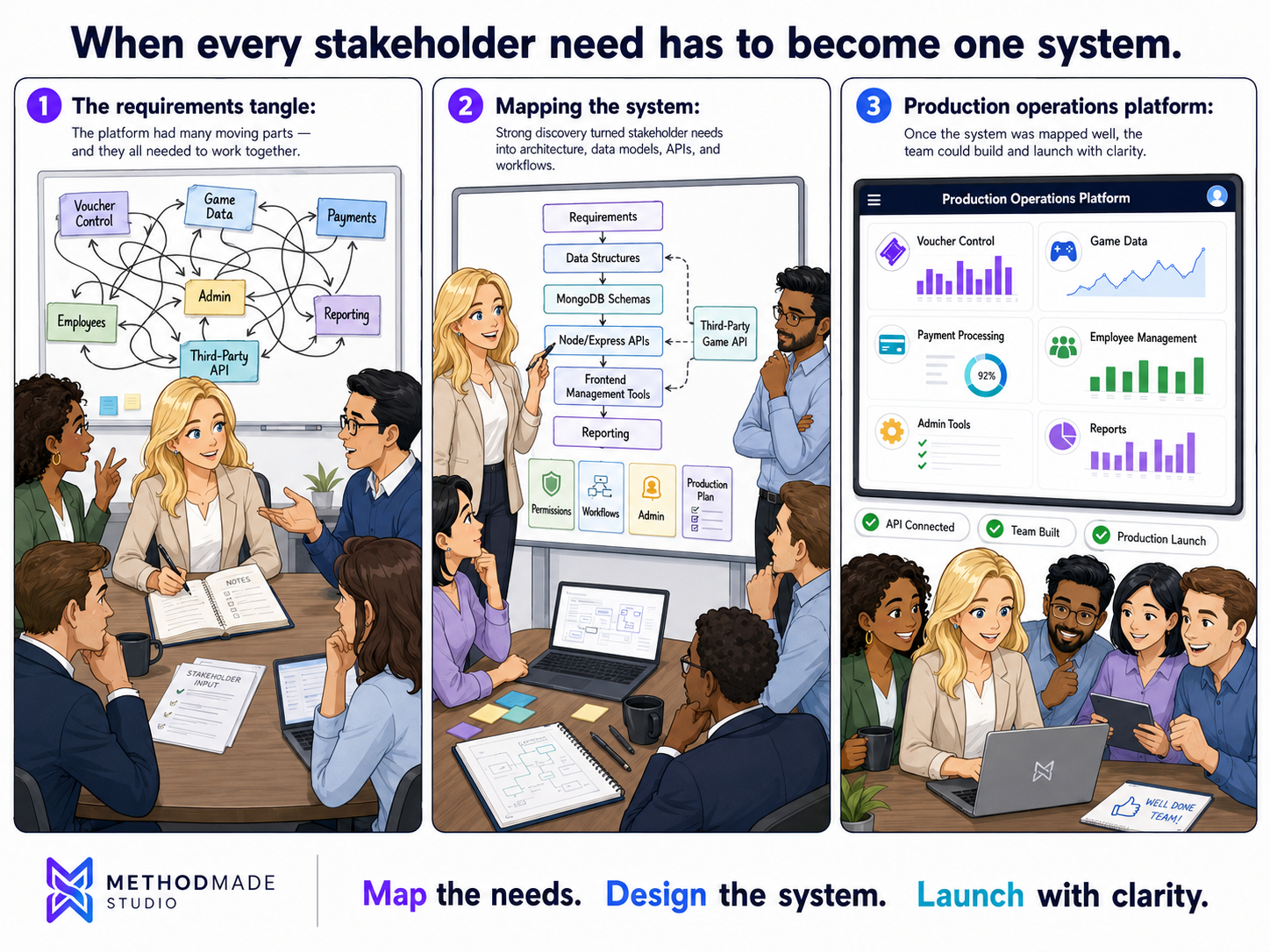
Visual recap
From paper sketches to a production operations platform.
Related practical guide
The Small-Business Tech Mess Map
Read the guide →Related experience
A practical next step
Turn the broad operating need into a system people can build and use
A systems map can clarify the workflows, permissions, data, integrations, and first useful release before implementation becomes expensive guesswork.