MethodMade Studio logo mark

MethodMade

Studio

← Back to experience

Technical discovery

Changing course when the original technical path hit real-world constraints

A kiosk payment integration needed honest technical judgment when the original Node controller approach ran into hardware and DLL constraints.

I worked on a kiosk management system that needed to integrate with a JCM iVizion bill acceptor using the JCM ID008 protocol over USB. The project required backend APIs, a frontend management interface, hardware communication, and a controller strategy that could reliably support the payment workflow.

I started by gathering requirements from stakeholders and investors, then designed the system architecture around the expected workflow. I also worked directly with JCM documentation and support to understand the hardware integration requirements.

My original plan was to build the controller in Node. Based on my previous hardware and controller work, that was a reasonable direction to investigate. But as the project moved deeper into the JCM iVizion integration, the USB controller requirements created constraints that made the Node approach impractical at the time. The controller path depended on DLL behavior that was better suited to a different implementation stack.

That was the key technical decision point.

Instead of forcing the original plan because it was the plan, I changed course. I brought in a C# developer to handle the controller constraints while the Node APIs and Angular frontend work continued successfully.

This project had a mixed result, but that is part of why it matters. Not every useful technical story is a perfect launch story. Sometimes the most important engineering judgment is recognizing when the first approach is no longer the right one.

The useful work was in the discovery, the architecture, the API and frontend foundation, the hardware research, and the willingness to adjust when real-world constraints appeared.

This project is a good example of technical course correction: knowing when to keep going, when to change tools, and when to bring in the right expertise before the wrong path burns too much time.
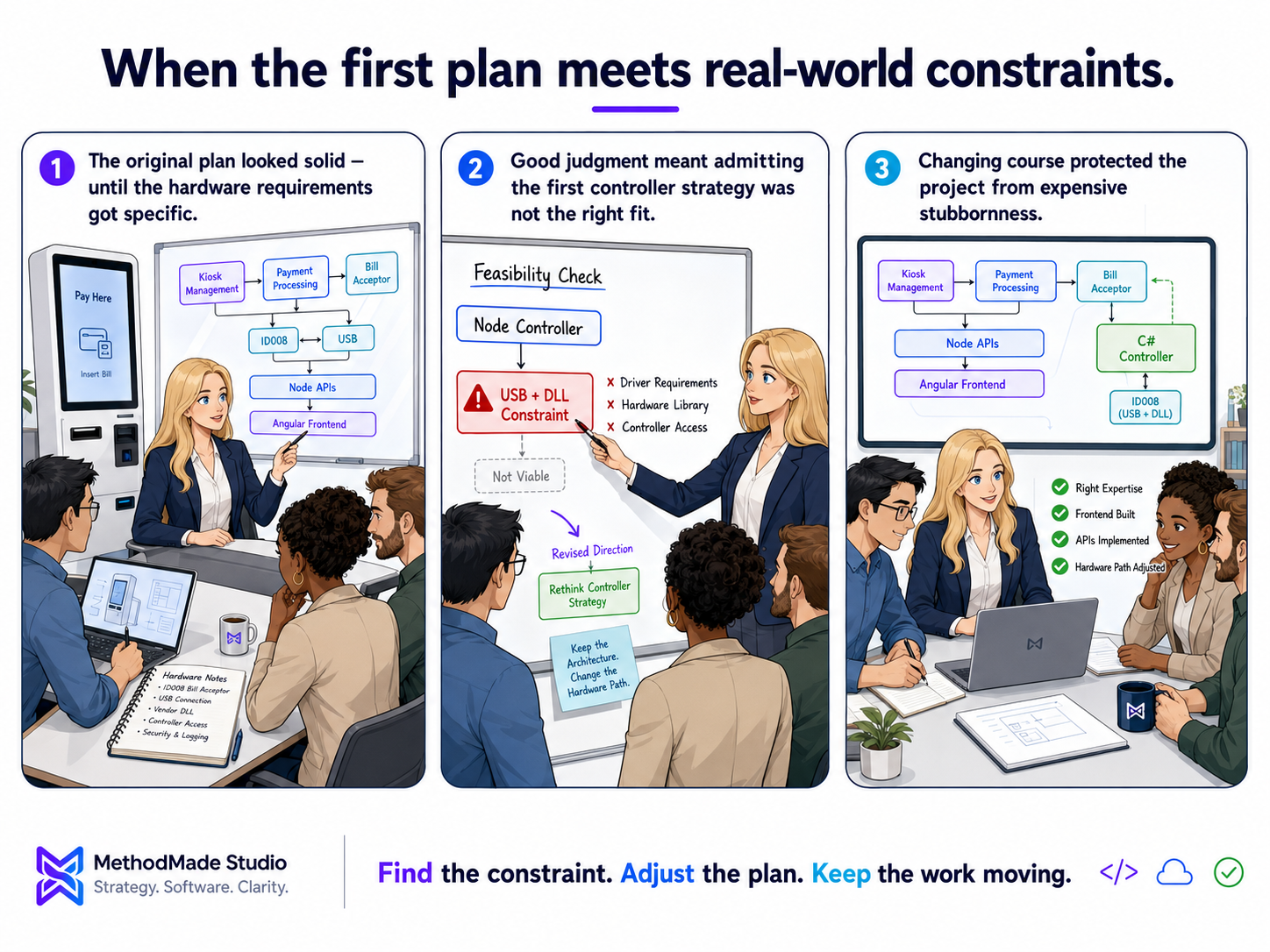
Visual recap

From technical assumption to honest course correction.

Three-panel MethodMade comic showing a kiosk hardware integration moving from an initial Node controller assumption to a course correction after USB and DLL constraints appeared.

How this applies

The same pattern shows up in smaller business systems too.

The scale may change, but the work still starts the same way: understand what is really happening, organize the moving parts, then build the next useful thing.

MethodMade translation

For a small business, that might mean clearer service pages, cleaner intake, better follow-up, usable documentation, or one practical automation.

1

Understand the real situation

Start by separating the visible problem from the actual workflow, people, tools, constraints, and risks underneath it.

2

Organize the moving parts

Turn the scattered pieces into a clearer map: what exists, what matters, what is missing, and what should happen next.

3

Build the next useful system

Create the practical next layer: a page, process, automation, document, or tool that can be understood and maintained.

Use this thinking for

  • Technical feasibility review
  • Hardware/software integration

Helpful when you need

  • Kiosk management systems
  • Payment workflow planning

Often connected to

  • JCM iVizion
  • ID008 protocol

Proof notes

Generic kiosk management systemIntegrated with JCM iVizion bill acceptorUsed JCM ID008 protocol over USBGathered requirements from stakeholders and investorsDesigned system architectureWorked from JCM documentation and supportOriginal controller plan used NodeUSB/DLL constraints made Node controller path impracticalChanged technical direction instead of forcing original approachBrought in C# developer for controller constraintsNode APIs successfully implementedAngular frontend successfully implementedMixed-result project with valuable technical course-correction lesson

Next step

Want this kind of practical systems thinking on your project?

Start with a free Discovery Call or a paid Tech Checkup if you want help choosing the right next move.