
Rescue the product, then stop solving the same customer variation over and over
An inherited chargeback product moved from architectural risk and team disconnection to a more stable, configurable platform with reusable templates, content, reporting, and workflow capabilities.
2 → 2.1
Rescue to extensible platform
The stabilized product evolved into a more configurable platform serving multiple merchant needs.
Lower workload
Customer Success burden
After launch, merchants could accomplish more through configuration and reusable product features.
Team growth
Larger engineering ownership
Engineers advanced into senior and lead roles, and the remaining QA engineer later became QA Lead.
The real situation
I inherited DisputeFlow 2 after the previous lead left. The product carried unclear requirements, architectural problems, risky dependencies, technical debt, and a team that had lost a shared direction.
The business also needed the platform to support different merchant data, content, and dispute-package requirements. Stabilizing the existing system was only the first step. The longer-term opportunity was to stop turning every customer variation into another isolated engineering implementation.
What the business was carrying
The visible problem
- A mature product had become difficult to extend safely.
- Critical workflows depended on deprecated or fragile technical behavior.
- The engineering team lacked shared direction, confidence, and clear ownership.
- Customer-specific needs repeatedly created pressure for one-off solutions.
Why the obvious fix was not enough
The harder system underneath
- Existing functionality had to remain available while the foundation changed.
- Document-heavy chargeback workflows combined templates, rules, reporting, dashboards, and generated output.
- Product rescue, continued delivery, cross-team testing, and team rebuilding all happened at the same time.
The two-part transformation
Stability created the room to make customer variation reusable
The rescue was not complete when the product could launch. The stronger outcome was a platform and team able to absorb future variation without returning to chaos.
Before
- Unclear direction and architectural risk
- Deprecated dependencies
- Disconnected engineering group
- One-off merchant requirements
After
- Successful DisputeFlow 2.1 evolution
- Lower Customer Success workload
- More reusable merchant capability
- Engineers grew into larger roles
- 01
Assess
Map product, technical, and team risk
Create one shared understanding before adding more work.
- 02
Stabilize
Improve foundations and delivery practices
Reduce repeated friction and make extension safer.
- 03
Configure
Build reusable customization
Use fields, snippets, templates, reporting, and rules instead of isolated features.
- 04
Enable
Grow ownership across the team
Pair, coach, and make quality a shared product responsibility.
What changed
Decisions that moved the work forward
- 1 Diagnose
Slow the chaos down enough to map it
I reviewed the architecture and codebase, clarified stories, used technical spikes, surfaced risks, and talked directly with stakeholders and engineers.
- 2 Stabilize
Create a foundation the team could extend
We improved technical direction, testing practices, dependency choices, and development patterns before accelerating feature work.
- 3 Generalize
Turn recurring variation into product capability
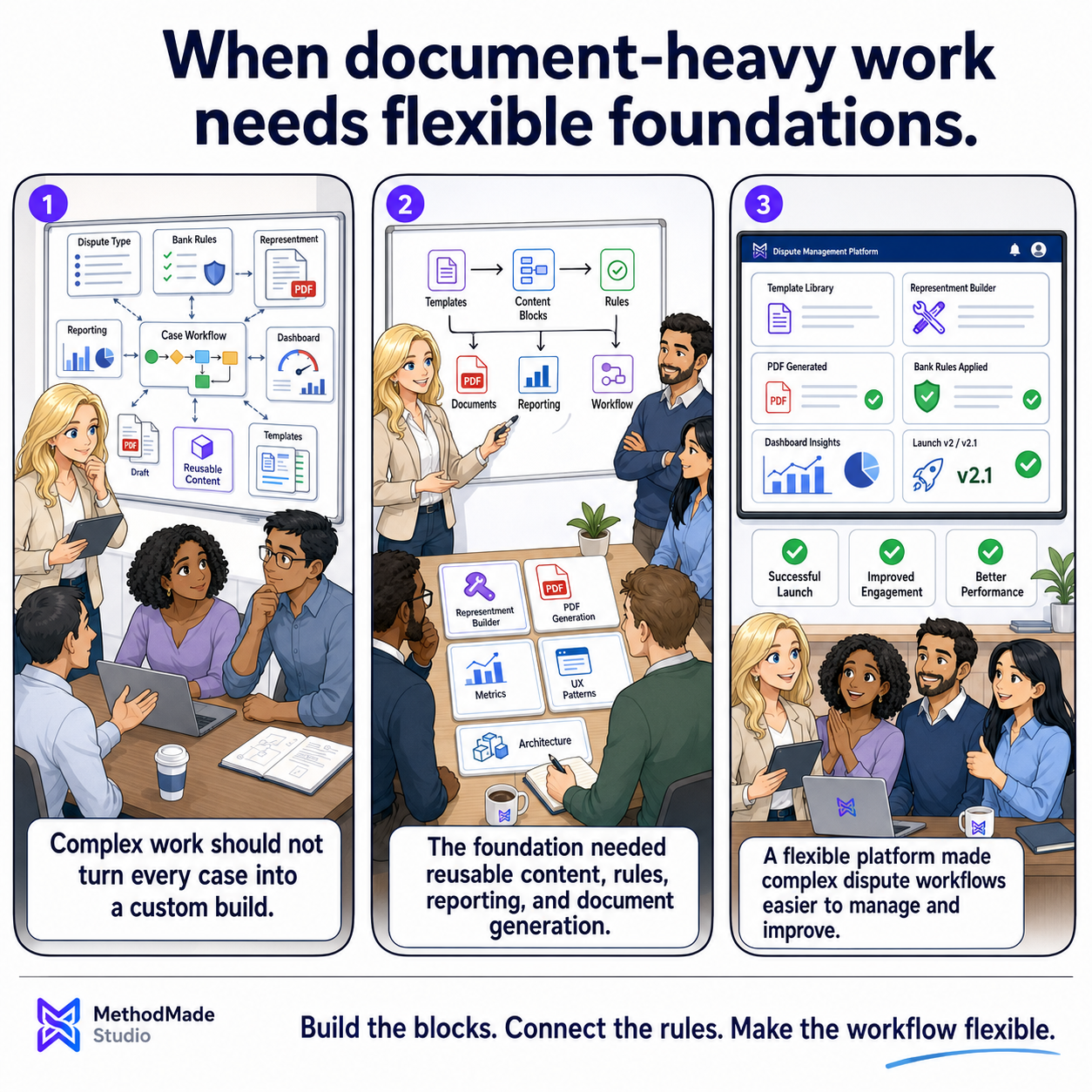
DisputeFlow 2.1 added merchant-defined custom fields, reusable content snippets, flexible templates, dashboards, reporting, document generation, and rule-driven workflows.
- 4 Grow
Build a team capable of owning the platform
Clear expectations, pairing, mobbing, meaningful ownership, and coaching helped engineers advance into senior, lead, and quality-lead responsibilities.
What the business gained
Results beyond the implementation
01
The product moved from rescue mode into deliberate platform evolution.
02
Reusable customization reduced the need for engineering to hard-code every merchant variation.
03
Customer Success carried less operational burden after the successful launch.
04
The engineering group became a more cohesive team capable of larger work.
What this proves for a client
The scale may change. The systems judgment still transfers.
A fragile product rarely needs more speed first. It needs a shared picture of the current state, a safer technical direction, and a decision about which repeated customer needs should become configurable product features. Rescue and platform design are connected.
Technical footprint
Evidence and boundaries
- ✓ DisputeFlow 2 stabilized and evolved into 2.1
- ✓ Reusable fields, snippets, templates, reporting, and document workflows
- ✓ Lower Customer Success burden
- ✓ Multiple team members grew into larger roles
Customer configurations, proprietary chargeback rules, private architecture, personnel circumstances, and implementation details remain generalized.
Visual recap
From a fragile inherited product to a more flexible platform.
Related practical guide
What to Do When the Project Is Half Built
Read the guide →A practical next step
Create a trustworthy path out of product rescue mode
A current-state review can separate urgent stabilization, unnecessary complexity, and the customer variation that should become reusable capability.