
Incompatible files become valuable only after the business can trust and use them
A standalone Node.js service translated unfamiliar daily SFTP files into the platform’s stable internal model and eliminated manual conversion for the supported pipelines.
Daily
Automated ingestion
Supported files were collected, translated, validated, and submitted without manual intervention.
2–3 months
First pipeline to production
The first source moved from schema investigation to dependable daily ingestion within the recalled delivery window.
Eliminated
Manual conversion
The prior conversion step was removed for the supported reporting-system pipelines.
The real situation
Prospective clients used reporting systems whose dispute-data structures did not match the platform’s existing ingestion logic. Unsupported files either required burdensome manual conversion or prevented onboarding altogether.
The differences went beyond field names. Records contained missing values, nested structures, inconsistent formats, and data points with no direct equivalent in the product. The system needed to translate business meaning—not merely rename columns.
What the business was carrying
The visible problem
- Daily files arrived through secure SFTP sources in incompatible structures.
- Manual conversion was slow, error-prone, and could become an onboarding blocker.
- Letting every external field reshape the product would make the internal model unstable.
Why the obvious fix was not enough
The harder system underneath
- A technically valid mapping could still be wrong in business terms.
- Malformed files and unexpected schema changes needed to fail visibly before entering production workflows.
- The focused implementation had to progress while the wider engineering team carried several other initiatives.
The translation boundary
External variability stopped at a controlled service boundary
The ingestion layer absorbed source-specific differences so the core platform and its existing workflows could remain stable.
Before
- Incompatible source schemas
- Manual file conversion
- Potential onboarding blocker
- External fields threatening internal-model sprawl
After
- Reliable daily production ingestion
- Stable internal data model
- Manual conversion removed
- More client environments supportable
- 01
Collect
Retrieve daily files securely
Keep provider-specific intake in a standalone scheduled service.
- 02
Interpret
Compare business meaning
Map equivalent concepts even when names and structures differ.
- 03
Validate
Stop malformed or uncertain data
Flag, retry once, and route unresolved files for investigation.
- 04
Deliver
Submit normalized records through the API
Reuse existing management, reconciliation, reporting, filtering, and export workflows.
What changed
Decisions that moved the work forward
- 1 Isolate
Keep unreliable external inputs outside the core product
I built a standalone scheduled Node.js service for collection, translation, validation, and API submission.
- 2 Translate
Map meaning before names
External values were mapped to existing keys when they represented the same business concept, even when their structure or labels differed.
- 3 Protect
Extend the internal model selectively
A new field was created only when the product value justified permanent complexity; low-value unmatched data was excluded.
- 4 Control
Stop questionable data visibly
Files were validated, failures were flagged, one retry was attempted, and unresolved exceptions were routed for investigation.
What the business gained
Results beyond the implementation
01
Previously incompatible records entered existing dispute management, reconciliation, reporting, filtering, and export workflows.
02
The internal product model stayed deliberate instead of absorbing every source-specific field.
03
The business could support client environments that had previously required manual conversion or could not be onboarded.
What this proves for a client
The scale may change. The systems judgment still transfers.
A dependable integration needs a boundary between outside variability and the internal system. MethodMade looks for the stable business concepts, translates only what matters, makes exceptions visible, and connects the result to the workflows where people can actually use it.
Technical footprint
Evidence and boundaries
- ✓ Standalone Node.js ingestion service
- ✓ Daily SFTP collection
- ✓ Selective schema extension
- ✓ Validation and controlled exceptions
- ✓ 2–3 month first-pipeline delivery
Clients, reporting-system providers, schemas, mappings, credentials, endpoints, dispute records, and proprietary business rules remain generalized.
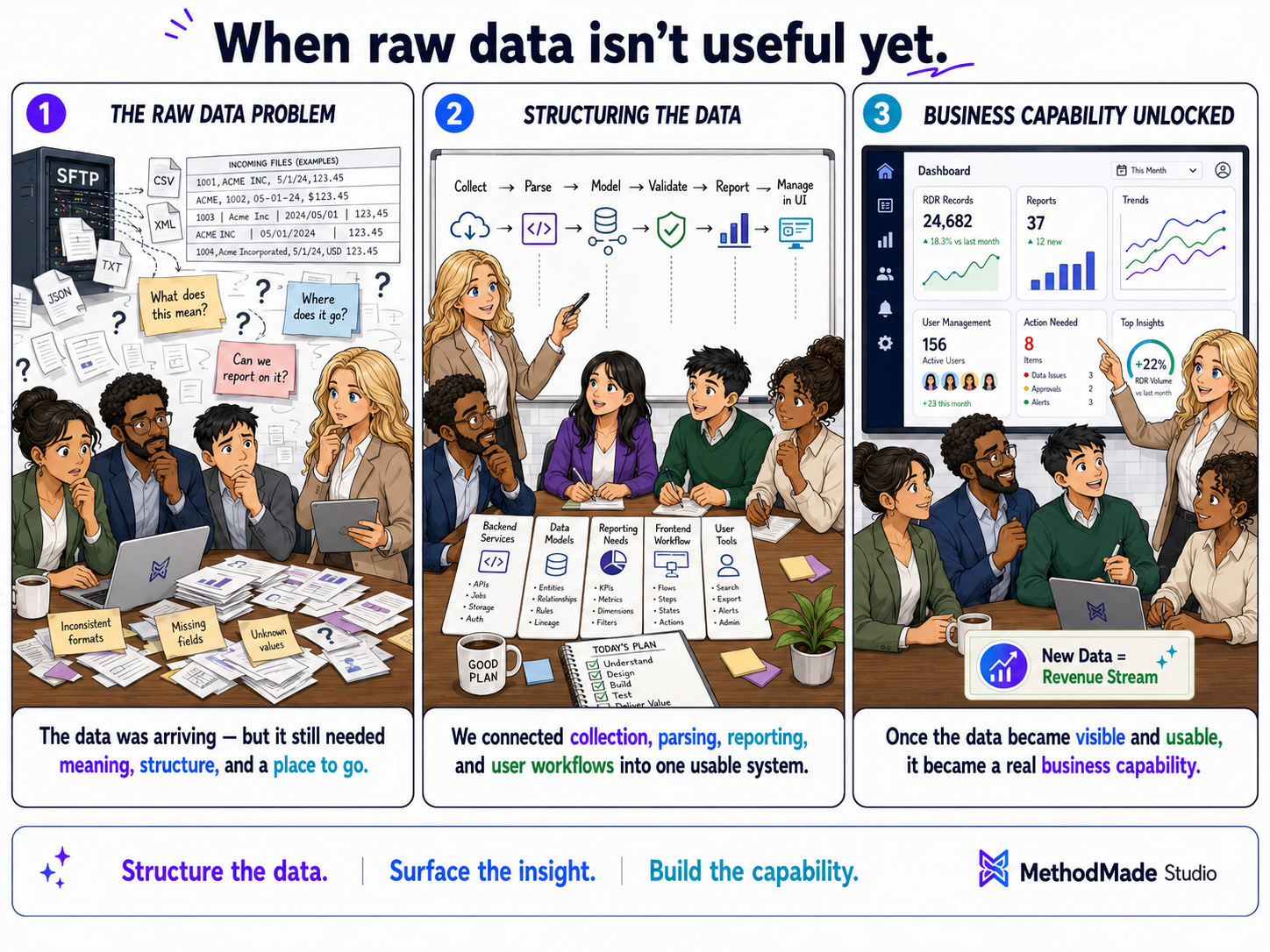
Visual recap
From incompatible data streams to a reliable product capability.
Related practical guide
Turn Data Into a Business Capability
Read the guide →A practical next step
Turn incoming data into something the business can trust and act on
We can map the sources, identify the stable internal concepts, and define where validation, translation, and operational visibility belong.